Two quotes for HDPE pellets landed on Daniel’s desk in Rotterdam last March. The first read $1.05 per kg on FOB Ningbo terms. The second read $1.19 per kg, delivered to his plant gate. He approved the cheaper one.
Six months later, his finance team calculated the real figure: $1.31 per kg. Freight, duty, port handling, and a demurrage charge he never saw coming had wiped out the saving and then some.
Daniel isn’t careless. He runs procurement for a packaging converter that consumes 4,000 tonnes of polyethylene a year. His mistake was comparing two numbers that were never comparable. That’s the trap in every HDPE pellets price conversation, and it costs manufacturers real money every quarter.
You likely already compare supplier quotes line by line, and you know the headline number hides something. This guide gives you the 2026 HDPE pellets price baseline by grade and region, then hands you the framework that turns any quote into a true landed cost per kg. You’ll get grade-level price tables, the virgin versus recycled gap, seven factors that move your real cost, a worked landed-cost example, and a method for benchmarking any quote you receive.
Want to skip ahead? Request a custom HDPE quote and we’ll return detailed per-grade pricing within 24 hours.
HDPE Pellets Price in 2026: The Short Answer

As of September 2026, virgin HDPE pellets traded at roughly **$0.95 to $1.30 per kg** through the first three quarters of the year. FOB China contracts sit at the low end near $0.99 per kg, while delivered European material reaches $1.30 to $1.40 per kg. Recycled HDPE spans a far wider band, from $300 per tonne for mixed-color regrind to $1,500 per tonne for food-grade deodorized pellet.
Those ranges are useless on their own. Grade, Incoterm, order volume, and certification swing the number you actually pay by 30% to 50%. A single “HDPE price” figure doesn’t exist, because HDPE isn’t one material. It’s a family of grades with different melt flow indexes, densities, and end uses, and each one prices differently.
Price Per Kg, Per Pound, and Per Tonne
Suppliers quote the polyethylene pellets price in different units, and the unit itself is a negotiation lever. Convert everything to one basis before you compare.
| Unit | Convert To $/kg | Example |
|---|---|---|
| $/lb | Multiply by 2.2046 | 0.55/lb=0.55/lb=1.21/kg |
| $/tonne (metric) | Divide by 1,000 | 1,190/tonne=1,190/tonne=1.19/kg |
| RMB/tonne | Multiply by 0.14, then divide by 1,000 | 8,470 RMB/tonne = $1.19/kg |
| €/kg | Multiply by 1.08 | €1.10/kg = $1.19/kg |
A supplier quoting $0.53 per pound is quoting $1.17 per kg. The same material at $1,190 per tonne is $1.19 per kg. One sounds dramatically cheaper than the other and isn’t. Normalize every quote to $/kg before you put it in a spreadsheet.
HDPE Pellets Price by Grade and Region
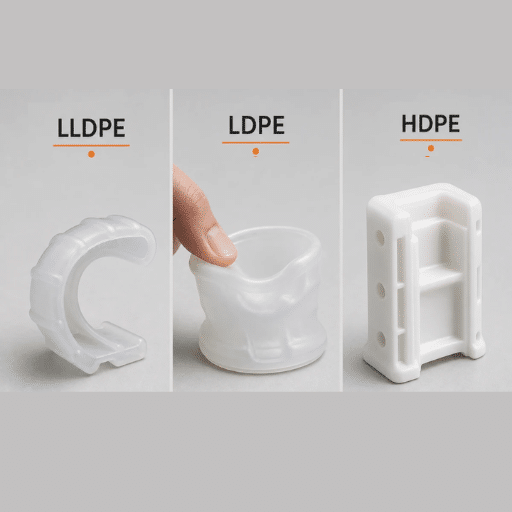
Grade sets the base price. Region sets the adjustment. Get both right and you can predict a fair quote before it arrives, whether your supplier sells HDPE granules or pellets. Our HDPE vs LDPE vs LLDPE comparison shows how much the grade itself changes the material.
HDPE Pellets Price by Grade
| Grade | Typical MFI (g/10 min) | Density (g/cm³) | 2026 Price Range | Primary Applications |
|---|---|---|---|---|
| Injection molding | 8 to 20 | 0.955 to 0.965 | 1.05to1.05to1.25/kg | Crates, caps, housewares, toys |
| Blow molding | 0.3 to 1.5 | 0.945 to 0.955 | 1.05to1.05to1.30/kg | Bottles, jugs, drums, fuel tanks |
| Film | 0.05 to 0.3 | 0.918 to 0.935 | 1.00to1.00to1.20/kg | Packaging film, bags, liners |
| Pipe (PE80/PE100) | 0.1 to 0.5 | 0.940 to 0.960 | 1.10to1.10to1.35/kg | Water and gas pipe, conduit |
| Rotomolding | 2 to 8 | 0.935 to 0.945 | 1.15to1.15to1.40/kg | Tanks, kayaks, playground parts |
Read that table again and notice what it doesn’t say. It never mentions the word “HDPE” as a differentiator, because HDPE is the constant. The melt flow index is what you are buying.
A film-grade resin at MFI 0.05 won’t run in an injection press, and an injection grade at MFI 12 won’t hold a parison in blow molding. When a supplier quotes you a suspiciously low price, the first question to ask is which MFI they’re quoting.
The Branded-Prime Premium
Branded prime grades from ExxonMobil, SABIC, Borealis, and LyondellBasell carry a premium of roughly $0.10 to $0.40 per kg over unbranded or domestic equivalents. ExxonMobil HD025 has been quoted at $1.52 per kg FOB Guangzhou, while comparable generic injection grades sit near $1.19 per kg.
That premium buys batch-to-batch consistency, a documented paper trail, and predictable flow behavior in a regulated process. It pays for itself in medical, food-contact, and automotive work where a failed lot shuts a line. It rarely pays for itself in crates, pallets, and general industrial parts, where an unbranded grade with a verified Certificate of Analysis performs identically.
HDPE Pellets Price by Region
| Region | 2026 Virgin HDPE Range | Why the Spread |
|---|---|---|
| China (FOB) | $0.99 to $1.35/kg | Integrated capacity, lowest ethylene cost, export-focused |
| United States | $1.15 to $1.25/kg | Cheap ethane feedstock, but domestic freight adds cost |
| Europe (delivered) | $1.30 to $1.40/kg | Highest energy costs, tight ethylene, carbon costs |
| India | $1.13 to $1.20/kg | Growing capacity, import competition |
| Southeast Asia | $1.05 to $1.25/kg | Import-dependent, freight-sensitive |
FOB China has held the global price floor for four straight years. That position comes from integration: Chinese producers control the chain from naphtha and ethane through polymerization, so they absorb feedstock swings faster than producers who buy ethylene on the open market.
One warning about regional tables. A $0.30 per kg gap between China and Europe disappears the moment you price freight, duty, and inland delivery on Chinese material bound for a German plant. The gap is real on paper and can be much smaller at your loading dock. Our complete polyethylene pellets sourcing guide walks through how to model that trade-off properly.
Virgin vs Recycled HDPE Pellets Price

Recycled HDPE isn’t one price point. It’s a ladder, and the top rungs have climbed above virgin material in some markets.
| Recycled Grade | 2026 Price Range | Typical Use |
|---|---|---|
| Basic mixed-color regrind | $300 to $500/tonne | Non-critical industrial parts, pallets |
| Mid-grade (injection/extrusion) | $510 to $810/tonne | Pipes, crates, drainage products |
| High-quality natural | $850 to $1,200/tonne | Containers, closures, visible parts |
| Food-grade deodorized | $1,100 to $1,500/tonne | Food contact packaging, beverage caps |
Set the virgin benchmark of $980 to $1,235 per tonne beside that table. Basic mixed-color recyclate is 55% to 70% cheaper. Food-grade recyclate is priced at a premium over virgin, which surprises buyers who assume recycled always means discount.
The reason is feedstock. Natural HDPE bale prices climbed more than 40 cents per pound since January 2026, an 83% jump, according to ICIS data reported by PlasticsToday. Food-grade rHDPE pellet prices rose nearly 50% year to date. Collection volumes can’t keep pace with compliance-driven demand from California SB54 and the EU Packaging and Packaging Waste Regulation, so certified recyclate has become the scarce input rather than the cheap one.
Priya manages materials for a Portuguese pipe extruder, and she learned this the expensive way. In February she switched 40% of her line from virgin HDPE to mid-grade recyclate, cutting material cost by $310 per tonne.
By April her scrap rate had climbed from 1.1% to 4.2%, because moisture and contamination varied between lots. The saving was real. So was the $40,000 in scrapped pipe.
We cover that quality-control question in depth in our guide to recycled and virgin polyethylene pellets, including how to specify a Certificate of Analysis that actually protects you.
Seven Factors That Move the HDPE Pellet Price You Pay
The market price is one input. Your buying decisions control the rest.
- Grade and MFI. The single largest variable. Moving from a film grade to a rotomolding grade can add $0.15 per kg with no change in chemistry.
- Virgin or recycled. Industrial grades run 30% to 45% cheaper recycled. Food-grade recyclate runs at parity or above virgin.
- Order volume. Volume breaks usually begin at 10,000 kg and reach roughly 30% off at the top end. Sub-$0.90/kg pricing generally requires 10,000 kg or more, and some suppliers hold it for 100,000 kg orders.
- Incoterms. EXW, FOB, CIF, and DDP can differ by 0.10to0.10to0.30 per kg for identical material from an identical plant. This is the number most buyers fail to isolate.
- Certification. FDA 21 CFR, EU 10/2011, GRS, RecyClass, REACH, and RoHS certification each add processing and documentation cost. Certification is often the entire reason recycled material costs more than virgin.
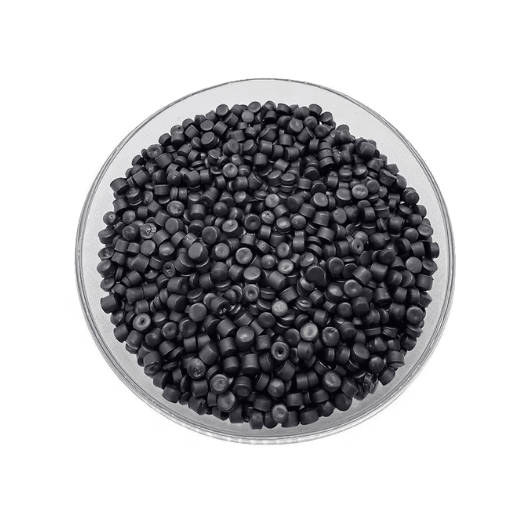
- Color, additives, and stabilization. Natural pellets are the base price. Black, custom colors, UV stabilizers, and flame retardants each add cost, and custom color runs carry minimum order penalties.
- Contract versus spot. Six- to twelve-month fixed contracts typically price 5% to 10% below spot and protect you from feedstock spikes. Spot buying wins only when you expect prices to fall and can absorb the volatility.
Notice that four of those seven factors have nothing to do with the resin market. They’re procurement decisions you make, and they determine more of your final cost than the daily polyethylene index does.
How to Calculate Your True HDPE Pellet Landed Cost
Here’s the framework. Lay every line item out and the $1.05 versus $1.19 comparison from the opening of this article resolves itself.
The Landed Cost Formula
Start with the supplier’s unit price on their Incoterm, then add every cost required to get material into your silo:
- Material price on the quoted Incoterm
- Freight if the Incoterm does not include it (FOB and EXW both exclude main carriage)
- Marine insurance, typically 0.3% to 0.5% of CIF value
- Import duty at your country’s tariff rate for the HS code
- Port handling, terminal charges, and customs brokerage
- Inland delivery to your plant
- Letter of credit and financing costs, often 1% to 2% of order value
- Demurrage and detention if containers sit too long
Worked Example: $1.10 per kg FOB China to a European Plant
Take a 20-tonne order of injection-grade HDPE quoted at $1.10 per kg FOB Ningbo, shipped to Rotterdam.
| Line Item | Cost per kg |
|---|---|
| Material, FOB Ningbo | $1.100 |
| Ocean freight, Ningbo to Rotterdam | $0.085 |
| Marine insurance | $0.004 |
| EU import duty (HS 3901.20) | $0.072 |
| Port handling and brokerage | $0.022 |
| Inland trucking to plant | $0.031 |
| Letter of credit and financing | $0.014 |
| True landed cost | $1.328 |
The quote said $1.10. You pay $1.33. That’s a 21% gap, and it’s entirely normal for Chinese material entering Europe. A domestic supplier quoting €1.05 per kg DDP, equivalent to roughly $1.13 per kg delivered, beats the “cheaper” import by $0.20 per kg before you account for a single day of customs delay.
Cost Per Conforming Part Beats Cost Per Kg
The landed cost still isn’t your final number. Part quality decides the rest. A $0.15 per kg saving on a 500-gram part is $0.075 of material saving per unit. If scrap rises 2% and your part sells for $8, you’ve lost $0.16 per unit and turned a saving into a loss.
Priya’s pipe line is the clean illustration. Cheaper resin, higher scrap rate, negative return. Calculate cost per conforming part, never cost per kg, before you switch grades or suppliers.
Need help modelling this? Our polymer specialists will build a landed-cost comparison for your specific grade, volume, and destination port. Talk to our team today.
How to Benchmark an HDPE Pellets Price Quote

A quote is only meaningful once you can test it. Five steps will separate a fair price from a trap.
Request the Certificate of Analysis before the price. Ask for melt flow index to ASTM D1238 and density to ASTM D792 per lot. A supplier who can’t produce a CoA isn’t selling you a specified material, and the price is irrelevant.
Normalize to one Incoterm and one volume. Re-quote every supplier on identical terms, either all FOB or all DDP, at your real annual volume. Most apparent price differences vanish at this step. The rest are the real differences.
Verify certification numbers with the issuing body. A claimed GRS or FDA registration is verifiable in minutes. Recycled food-grade material attracts counterfeit documentation because the certification is what buyers are paying for.
Run a trial batch before you commit. 25 to 100 kg for a screening run, 500 kg to 1 tonne for a full production trial. This is the cheapest insurance in procurement and it’s how Priya would have caught her moisture problem for $600 instead of $40,000.
Treat deeply sub-market quotes as a signal. A quote 25% below every other supplier is telling you something about MFI accuracy, filler content, or lot traceability. Our guide to the top HDPE pellets suppliers covers the vetting criteria that separate manufacturer-direct sources from brokers.
HDPE Pellet Price Outlook for the Rest of 2026
Expert Market Research projects global HDPE averaging $1.06 to $1.20 per kg through the remainder of 2026. That forecast follows an 11.3% full-year decline from $1.240 per kg in Q1 2025 to roughly $1.100 per kg in Q4.
The supply picture explains the softness. China is commissioning an estimated 565,000 to 603,000 tonnes of new polyethylene capacity in 2026, a 14% annual increase, and the additions are concentrated in HDPE grades during the second half.
Crude oil remains the dominant cost driver, and it’s pointing down. As the geopolitical premium from Middle East disruptions unwinds, analysts expect cost support to weaken into 2027. Recycling International reports that certified recyclate premiums are moving the other way, widening as 2030 recycled-content mandates approach.
The practical read for procurement teams: virgin HDPE looks range-bound to soft for the next two quarters, which favors negotiating now while producers want volume commitments. Certified recycled material looks structurally tight, so lock your rHDPE supply before you need it.
Frequently Asked Questions About HDPE Pellets Price

How much does HDPE cost per kg?
Virgin HDPE pellets cost $0.95 to $1.30 per kg in 2026, with FOB China near $0.99 per kg and delivered European material at $1.30 to $1.40 per kg. Recycled HDPE ranges from $0.30 to $1.50 per kg, depending on grade and certification.
Why are recycled HDPE pellets sometimes more expensive than virgin?
Certified food-grade recyclate trades above virgin material because feedstock is genuinely scarce. Natural HDPE bale prices rose 83% in 2026, and compliance demand from SB54 and the EU PPWR outpaced collection volumes. Sorting, deodorizing, and certification add cost that virgin polymerization doesn’t carry.
What is the cheapest way to buy HDPE pellets in bulk?
Order above 10,000 kg to reach volume breaks, and above 100,000 kg for the lowest tiers. Buy unbranded grades when your application doesn’t require a documented brand chain. Choose mixed-color recyclate for non-critical parts, and always compare quotes on identical Incoterms before deciding anything is cheaper.
Does HDPE pellet price depend on color?
Yes. Natural pellets are the base price, and black is often discounted since carbon black hides contamination. Custom colors add cost plus a minimum order penalty. If a custom color is negotiable, switching to a standard black or natural grade can cut material cost measurably.
Will HDPE prices go down in 2026?
Most likely, somewhat. Expert Market Research projects $1.06 to $1.20 per kg for the rest of 2026, and Chinese capacity additions concentrated in HDPE are pressuring prices downward. Certified recycled grades are the exception and may keep rising.
Transparent HDPE Pellets Pricing From Suzhou Yifuhui
Suzhou Yifuhui New Material supplies HDPE plastic pellets from $1.10 per kg, with pricing published per grade rather than hidden behind a “contact us” form. We manufacture and distribute standard and engineering plastics for packaging, construction, automotive, and consumer goods producers, and we ship internationally.
Every order ships with a Certificate of Analysis documenting melt flow index and density per lot. Our technical team answers material selection questions seven days a week and returns detailed quotations within 24 hours. Because we source directly, we carry no broker margin between our production and your quote.
Request a custom HDPE quote. Send us your grade, MFI target, annual volume, and destination port, and we will return landed pricing with the Incoterm terms spelled out line by line.
Conclusion: The Number That Matters
The HDPE pellets price you see on a quote is an opening position, not a cost. Four things decide what you actually pay:
- Grade and MFI set the market baseline, because HDPE is a family of materials rather than a single commodity.
- Incoterms and volume move the price by $0.10 to $0.30 per kg, more than most buyers isolate.
- Virgin versus recycled is no longer a simple discount, since food-grade recyclate now trades at a premium over virgin.
- Cost per conforming part is the only figure that reflects reality, because scrap and downtime erase per-kg savings quickly.
Normalize every quote to one unit and one Incoterm. Request the CoA before you discuss price. Run a trial batch before you commit to tonnes.
Daniel now models landed cost before he opens a single quote, and he has not been surprised by a demurrage charge since. If you want an HDPE pellets price you can compare with confidence, request a custom quote and we’ll show you the full breakdown.