Two quotations for polyethylene film pellets land in Daniel’s inbox on the same morning. Both say “LDPE film grade, 25 kg bags, delivered.” The price per tonne differs by 9%, so the cheaper one looks like the obvious answer.
Daniel runs a blown film line making 20 µm lamination film. One of those two quotations is a low-flow heavy-duty grade running at a melt index of 0.2, built for greenhouse covers and canal lining. On his line it will not hold a stable bubble at that gauge. The other is a general-purpose grade at melt index 4.0, which is what he actually needs.
Nothing in either quotation tells him which is which. That gap between a category label and a real specification is what this guide closes.
Polyethylene film pellets are the pelletised PE resin that converters melt and extrude into blown or cast film. “Film grade” only narrows the field. The specification decides whether the material runs on your line or stops it. Below you’ll find how to move from a film requirement to a written pellet specification: MFI, density, comonomer, additive package, and the exact lines to put on a request for quotation.
Need a grade matched to your line today? Send our material team your film thickness, process and target properties. Talk to a polymer specialist and we’ll come back with a density and MFI window.
What Are Polyethylene Film Pellets?

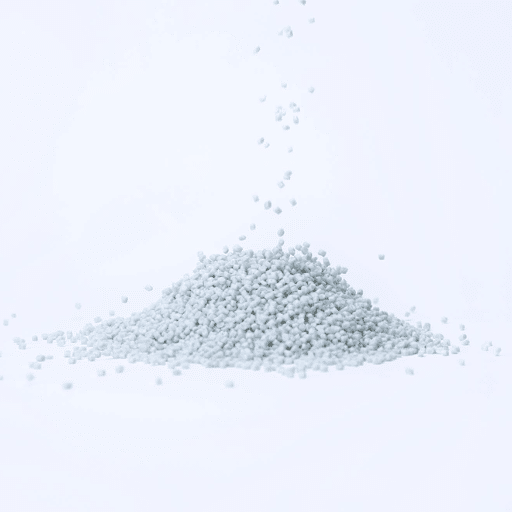
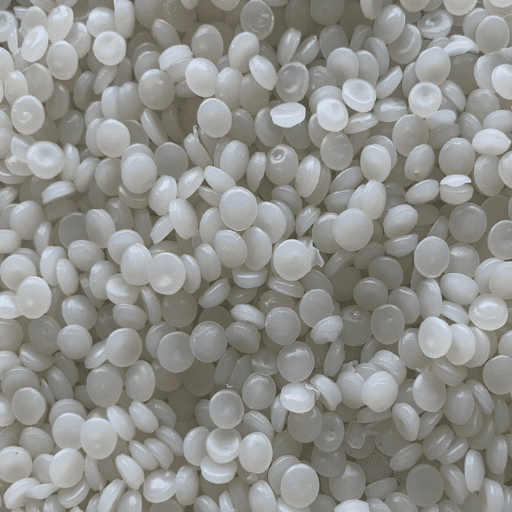
Polyethylene film pellets are pelletised polyethylene resin, typically 1 to 7 mm in diameter and 30 to 100 mg in weight, that serves as the feedstock for film extrusion.
Resin producers compound the polymer with antioxidants and additives, melt-extrude it into strands, and cut those strands into pellets. The converter then melts the pellets again and forms them into blown or cast film. Pellet form is what makes the material pourable, dosable and consistent from bag to bag.
Pellets, Flake and Repro: Why Form Matters
Most film-grade resin reaches the converter as pellet. That isn’t only a handling convenience. It’s a quality decision, and one the keyword you searched already points at.
Flake retains moisture more readily than pelletised material. Moisture that doesn’t fully melt before a vent can fill the vent area and block air and steam from escaping, which shows up on the film as gels, voids and bubble instability. Standard blown film troubleshooting guidance on the subject is blunt: use pellet instead of flake.
If you run repro or regrind alongside virgin resin, check four things on arrival:
- Fines and dust, which convey unevenly and can cause feed surges
- Size consistency, since mixed pellet geometry melts at different rates and creates unmelt
- Chalking and surface bloom, which can signal additive migration or aging
- Bag integrity, because moisture-barrier packaging only works while it is intact
For the terminology question that sits underneath all of this, our guide to the difference between granules and pellets covers when each term applies.
Which Polyethylene Makes Film? LDPE, LLDPE, mLLDPE and HDPE
Four polyethylene families carry most film production, and they differ in how they behave in the bubble:
- LDPE (Low-Density Polyethylene): long-chain branching gives it high melt strength, a forgiving bubble, excellent clarity and easy sealing. Density 0.91 to 0.93 g/cm³, processed around 210 °C.
- LLDPE (Linear Low-Density Polyethylene): linear chains, no long-chain branching. Higher toughness, puncture and tear resistance, but a narrower processing window. Density 0.91 to 0.94 g/cm³.
- mLLDPE (metallocene LLDPE): single-site catalysed. Better optics and sealing performance, but a tighter processing window. Processed around 225 °C.
- HDPE (High-Density Polyethylene): stiffest of the group with the best moisture barrier. Density 0.93 to 0.97 g/cm³, processed around 220 °C. Used for thin-gauge film, shopping bags and liners.
Blending is standard practice, not a workaround. Adding LDPE to an LLDPE-dominant formulation acts as a processing aid: the long-chain branches raise melt strength and stabilise the bubble without giving up the mechanical advantage of the linear resin. Producers design for this. LyondellBasell’s Petrothene GA503, a butene LLDPE at melt index 3.5 and density 0.925, is documented as blendable with LDPE to improve drawdown without bubble breaks.
The family choice is the subject of its own comparison. If you’re deciding between them from scratch, start at the HDPE film pellets end of the range.
Blown Film vs Cast Film: What Changes in Your Pellet Specification
The process you run changes the polyethylene film pellets you should buy, even when the end product is the same.
| Blown film | Cast film | |
|---|---|---|
| Forming | Tube inflated from an annular die; biaxial orientation controlled by blow-up ratio | Extrudate through a slit die onto chilled chrome rolls, pinned by an air knife |
| Gauge uniformity | Lower | Higher |
| Optics | Lower | Higher; better gloss and clarity |
| Orientation | Balanced MD/TD | Heavily MD-dominant |
| Scrap | Very low once the bubble is stable | Higher at start-up and trim |
| Typical thickness | Down to roughly 10 µm | Thinner films, higher output |
| Resin demands | Melt strength, broad or bimodal MWD for bubble stability | Shear thinning at the die lip, rapid cooling tolerance |
That last row is the part buyers underestimate. LDPE processes easily because long-chain branching generates strain hardening and a strong melt. LLDPE has no long-chain branching and a narrower molecular weight distribution, so it shear-thins less.
Here’s the practical consequence. Running straight LLDPE means more screw torque and pressure, higher melt temperatures, a wider die gap, and greater melt-fracture risk. Output on an LDPE line typically drops when you switch to straight LLDPE.
None of that makes LLDPE the wrong choice. It makes it a choice with a line-level cost, and that cost belongs in the same conversation as the per-tonne price. Where PE sits among the polyolefins more broadly is covered in our PP plastic pellets range comparison.
Film-Grade Pellet Specifications: MFI, Density and Comonomer

Three numbers decide whether a film-grade pellet suits your line: melt flow index, density and comonomer.
Melt Flow Index: the Master Dial
Polyethylene MFI is measured at 190 °C under ASTM D1238 or ISO 1133. The standard allows several loads, most commonly 2.16 kg or 5.0 kg, and this is where a specification most often goes wrong: a melt index measured at 2.16 kg and a melt flow rate measured at 5.0 kg are not comparable numbers. Always state the load alongside the value.
Lower MFI means a stiffer melt with better melt strength, which supports a larger bubble and easier cooling at height, but raises melt pressure and lowers output. Higher MFI runs more easily but narrows the operating window.
Published LDPE film grades span a wide range and the window moves with the application:
- Adhesive lamination and foam film: MFI around 2.0, density 0.920
- General-purpose film: MFI 0.6 to 4.0, density 0.920 to 0.924
- Heavy-duty bags, canal lining, greenhouse film: MFI 0.2 to 0.6, density 0.920
- Extrusion coating: MFI around 7.0, density 0.917
Density: Stiffness and Barrier
Density tracks crystallinity. Higher density raises stiffness, melting point and moisture barrier, but also raises gel risk and produces a drier, more matte film. It also lets the film hold strength at lower thickness, which is where density connects directly to cost.
Comonomer: Why Two “LLDPE” Grades Differ
LLDPE is an ethylene copolymer, and the alpha-olefin comonomer changes the film even when MFI and density match. C4 (1-butene), C6 (1-hexene) and C8 (1-octene) are the common options. Octene copolymer grades give better optical properties than butene grades at equivalent density, which is why some producers label them separately as C8L and C4L.
Film-Grade Selection Matrix
| Application | Process | Family | MFI (190 °C) | Density (g/cm³) | Comonomer | Additive package |
|---|---|---|---|---|---|---|
| Heavy-duty sacks, greenhouse, canal lining | Blown | LDPE | 0.2–0.6 | 0.920 | n/a | Typically barefoot or light slip |
| Heavy-duty blown film | Blown | LLDPE | ~1.0 | 0.918 | C8 or C4 | With or without slip & AB |
| Heavy-duty liquid packaging | Blown | LDPE | ~0.6 | 0.920 | n/a | Barefoot |
| General-purpose film | Blown / cast | LDPE | 0.7–4.0 | 0.923–0.924 | n/a | Barefoot or slip & AB |
| General-purpose blown film | Blown | LLDPE | 1.0–2.0 | 0.918 | C4 | With slip & AB |
| High-speed cast film | Cast | LLDPE | ~3.0 | 0.920 | C8 | No slip or AB |
| Adhesive lamination, foam film | Blown / cast | LDPE | ~2.0 | 0.920 | n/a | Barefoot |
| Extrusion coating | Coating | LDPE | ~7.0 | 0.917 | n/a | Barefoot |
| Stretch wrap | Blown / cast | LLDPE, mLLDPE | 1.0–3.5 | 0.918–0.925 | C6 or C8 | High slip, high AB |
Figures follow published LDPE and LLDPE film-grade ranges from producers such as Relene. Treat them as a starting window, not a universal standard.
Commercial grade codes such as 7042, 2426H or O19010 belong to the producer that issued them. They are families, not a global naming system. The portable specification is always density, MFI with its test load, comonomer, additive status and certification.
Slip, Antiblock and Food-Contact Compliance
Two pellet specifications cause more film defects than any other: the slip and antiblock package, and the compliance documentation.
Slip and Antiblock: the Barefoot Question
Slip agents are fatty acid amides, most commonly erucamide, oleamide, stearamide, behenamide or EBS. They migrate to the film surface and lower the coefficient of friction so layers slide instead of gripping. Typical loadings run 200 to 2,000 ppm, though effective ranges in practice run from below 200 ppm to around 2% by weight depending on the system.
Antiblock agents do a different job. Talc, diatomaceous earth, silica and calcium carbonate create controlled surface roughness so adjacent layers do not weld together on the reel. Masterbatch suppliers publish combined products to simplify dosing: ALKAMIX MB6005 carries 8% erucamide and 25% antiblock, recommended at 1% to 2% addition.
Coefficient of friction is where you verify the result. ASTM D1894 readings of 0.30 to 0.5 are fair, and below 0.30 is the target range for most packaging films.
Here’s the commercial point that decides whether your film works. Producers sell the same base grade both with and without slip and antiblock. In the Relene catalogue, O19010 is a C8 LLDPE blown film grade with slip and AB; O21010 is the same MFI, density and comonomer without them.
Order the wrong one and you get a film that blocks on the reel or a surface that won’t hold print or a seal. The fix is a single line on your purchase specification: state barefoot or state the loading.
Metallocene grades need more attention here, not less. Ziegler-Natta LLDPE blown film can develop an amorphous surface region that accumulates slip, while mLLDPE films typically need higher slip levels to reach the same coefficient of friction.
There’s a second interaction to watch. Slip agents and antistatic additives are both surface-migratory, so combining them can interfere with corona treatment, sealing and printing. Some suppliers explicitly caution against pairing a very high-slip grade with an antistatic.
Food-Contact and Compliance
Food packaging film raises the regulatory stakes for polyethylene film pellets, and the citation matters as much as the certificate.
In the United States, olefin polymers for food contact fall under FDA 21 CFR 177.1520. Specific sub-sections carry different permissions, including 21 CFR 177.1520(c) 3.1a, which can restrict use to film form, and 177.1520(c) 3.2a for olefin copolymers. Use conditions follow the A to H table in 21 CFR 176.170(c), and manufacturing runs under GMP per 21 CFR 174.5.
In the European Union, Regulation (EU) No 10/2011 governs plastic food-contact materials. Compliance is demonstrated against an overall migration limit of 10 mg/dm². For the Chinese market, the relevant standards are GB 4806.6-2016 and GB 9685-2016, and many international film grades carry these alongside FDA and EU approval.
One boundary is worth stating plainly. A base-resin compliance statement doesn’t transfer to the finished film.
Resin suppliers consistently place responsibility for the finished article on the converter or food packager, because additives, layer structure, processing and migration all change the outcome. If your film uses recycled content for food contact, that route requires a Letter of No Objection from the FDA.
Specifying Polyethylene Film Pellets: The RFQ Checklist
An RFQ that names a family and a tonnage will get you a price. An RFQ that names these ten things will get you the right material.
- Family and intention, LDPE, LLDPE, mLLDPE, HDPE, or a stated blend ratio
- Film process and thickness, blown or cast, and the target gauge in microns
- MFI with its test load and method, for example, 2.0 g/10 min at 190 °C / 2.16 kg, ISO 1133
- Density in g/cm³, with the test method
- Comonomer type for LLDPE, C4, C6 or C8
- Slip and antiblock status, barefoot, or the target loading and coefficient of friction
- Certification required, the specific FDA sub-section, EU 10/2011, or GB standard
- Virgin or recycled, and the recycled content percentage if applicable
- Form and packaging, 25 kg moisture-barrier bags, or 1,000 kg big bags
- MOQ, Incoterms and lead time, plus whether a sample lot is available before the bulk order
Item three is the one most often omitted and the one that costs the most. Because a 2.16 kg melt index and a 5.0 kg melt flow rate describe different measurements, an RFQ that omits the load can be answered correctly and still deliver the wrong resin.
Cost deserves the same scrutiny. Resin runs roughly $550 to $850 per tonne for virgin LDPE film grade and $550 to $1,200 for virgin LLDPE, with recycled film grades of LLDPE in the $550 to $600 range. But the relevant figure is cost per metre of film, not cost per kilogram of resin.
Consider what downgauging does to that calculation. At equal strength, LLDPE allows 20% to 25% less gauge than LDPE, and LDPE/LLDPE blends allow 30% to 40%. Stretch wrap illustrates it: LLDPE runs at 17 to 24 µm where LDPE needs 25 to 38 µm, and LDPE shrink wrap sits at 45 to 75 µm. A slightly higher resin price can still lower your film cost per pallet.
For the wider material trade-offs, our PE pellets versus PVC pellets comparison covers industrial film applications.
Ready to convert your film requirement into a specification? Send us your gauge, process and target properties, and we’ll return a density and MFI window with documentation.
Frequently Asked Questions

What are polyethylene film pellets?
Polyethylene film pellets are pelletised PE resin, usually 1 to 7 mm across, that converters melt and extrude into blown or cast film. Producers compound the polymer with antioxidants and additives, extrude it into strands and cut them into pellets. Pellet form keeps the material pourable, dosable and consistent from bag to bag, and it holds moisture less readily than flake.
What is the difference between LDPE and LLDPE film pellets?
LDPE has long-chain branching, which gives it high melt strength, a forgiving bubble and easy sealing. LLDPE is linear, so it delivers higher puncture and tear resistance but needs a wider die gap and more screw torque. An LLDPE film grade typically allows 20% to 25% less gauge at equal strength than an LDPE film grade. Most converters blend the two rather than choosing one.
What MFI do I need for blown film?
It depends on the application, not the process alone. Heavy-duty sacks and greenhouse film run at MFI 0.2 to 0.6 for maximum melt strength. General-purpose film sits at 0.6 to 4.0. Extrusion coating needs around 7.0 so the melt flows at high line speed. Always quote the test load, because a 2.16 kg melt index and a 5.0 kg melt flow rate are not the same measurement.
What is a blown film grade resin?
A blown film grade resin is a polyethylene formulated for tube extrusion. It needs enough melt strength to hold an inflated bubble and enough molecular weight distribution to run stably at the target gauge. Blown film grades are usually supplied with a stated slip and antiblock status, because that package decides how the finished film handles on the reel.
Which PE grade is used for stretch film?
Stretch film resin is normally an LLDPE or mLLDPE grade at MFI 1.0 to 3.5 and density 0.918 to 0.925, carrying a high slip and high antiblock loading. mLLDPE pellets have an edge here. Their narrower comonomer distribution gives better puncture resistance and holding force at thin gauge, which is why premium stretch wrap runs thinner for the same load.
Are polyethylene film pellets food safe?
The base resin can be, but the answer depends on the grade and the documentation. In the United States, food-contact olefin polymers are covered by 21 CFR 177.1520, with use conditions set by 21 CFR 176.170(c). The EU applies Regulation 10/2011, and China applies GB 4806.6-2016. A resin compliance statement does not transfer to the finished film; that responsibility sits with the converter or packager.
What should I put on an RFQ for film pellets?
Name the film grade polyethylene family and blend ratio, the blown or cast process and target gauge, MFI with its test load and method, density with its method, comonomer type, slip and antiblock status, the certification you need, virgin or recycled content, packaging, and your MOQ and Incoterms. Those ten lines are the difference between a price and a specification.
Polyethylene Film Pellets from Suzhou Yifuhui
Delivering the right grade starts with documenting it. Suzhou Yifuhui New Material Co., Ltd. supplies LDPE, LLDPE and standard polyethylene film grades alongside a complete portfolio of standard and engineering plastics, so a film converter and a moulding plant can consolidate their resin sourcing with one partner.
- Documented specifications: lot-traceable certificates of analysis with density and MFI verification, and slip/antiblock status disclosed rather than assumed
- Compliance support: food-contact grades supplied with the relevant FDA, EU and GB documentation for your assessment
- Batch consistency: standardised processes for uniform pellet size and melt flow, so your bubble behaves the same on lot ten as it did on lot one
- Global shipping: 25 kg moisture-barrier bags and 1,000 kg big bags delivered to your plant, with a 24-hour response on technical enquiries
Film-grade selection rewards precision. Density, MFI with its load, comonomer and additive status are the four lines that separate a quotation that works from one that sits on a shelf. Put them in writing, and the grade that arrives will be the grade your line needs. Request a quotation for polyethylene film pellets and our specialists will match the specification to your process. To gain a deeper understanding of Polyethylene Pellets Supplier: HDPE, LDPE & LLDPE Guide and Polyethylene Pellets Types & Grades: The Complete Reference, please refer to our accompanying guides.