Your injection molding machine just jammed for the third time this week. The culprit? Standard UHMW powder that was never designed to flow through a screw barrel.
If you’ve ever watched a production line go down because someone treated ultra-high molecular weight polyethylene like ordinary HDPE, you already understand the cost of getting UHMW processing wrong. A single misprocessed batch can waste $10,000 or more in material, labor, and missed delivery deadlines.
This guide delivers the exact UHMW processing parameters your team needs. You will learn how to compression mold large blocks, ram extrude continuous profiles, machine precision parts, and identify which specialty grades actually work for injection molding.
Every section includes temperature ranges, pressure values, and equipment specifications. Take them straight to the shop floor.
Need help selecting the right UHMW grade for your equipment? Our polymer specialists review your process requirements and recommend the exact powder or pellet grade before you place an order. Contact our team for a free technical consultation.
Here’s what you’ll get: a same-day grade recommendation, pricing, and a sample batch option.
Why UHMW Is Difficult to Process

UHMWPE carries a molecular weight of 3 to 10 million g/mol. That is roughly 10 to 100 times higher than standard HDPE, which sits at roughly 500,000 g/mol. Those ultra-long polymer chains deliver exceptional wear resistance and impact strength. They also create a processing challenge that catches many manufacturers off guard.
The material does not melt into a free-flowing liquid. Instead, it softens into a viscous gel with a melt viscosity near 10^8 Pa·s. Standard thermoplastics like PP or ABS flow easily through screw extruders and injection barrels. UHMW resists that flow so aggressively that conventional screw extrusion is effectively impossible without specially modified grades.
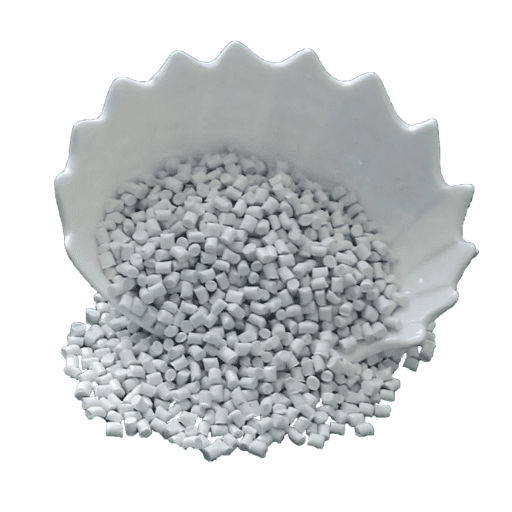
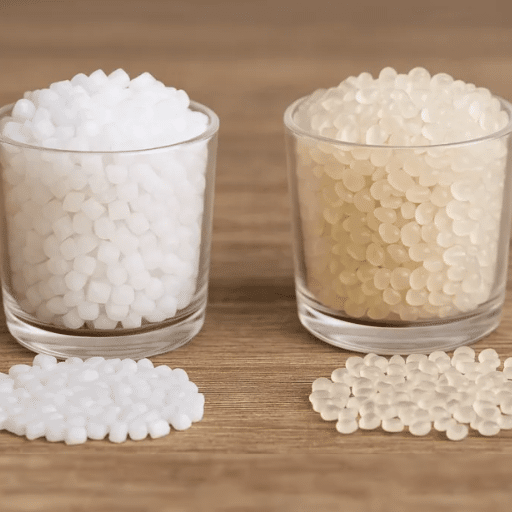
Most UHMW arrives as a fine powder, not pellets. That form factor works perfectly for compression molding and ram extrusion, but it confuses procurement teams who expect pelletized feedstock like HDPE or nylon. The powder flows poorly in standard hopper systems, bridges in feed throats, and requires different handling protocols than conventional plastic pellets.
When Marcus, a plant engineer at a Midwest conveyor manufacturer, ordered 500 kg of standard UHMW powder for his injection molding line in March 2026, he assumed the material would behave like the HDPE pellets his team ran daily. The screw seized within 20 minutes.
By the time his maintenance crew cleared the barrel and replaced the damaged screw tip, he had lost 8 hours of production and $4,200 in labor and material. The problem wasn’t defective resin. It was the wrong form factor for the wrong process.
Understanding these fundamentals before you source material saves more than money. It protects your equipment, your schedule, and your reputation with customers. To learn more about UHMW Material Properties: Complete Technical Specifications Guide, please click to refer to our accompanying guide.
UHMW Processing Methods at a Glance
Not every manufacturing environment can handle UHMW, and not every UHMW grade suits every process. The table below gives you a rapid decision framework.
| Processing Method | Best For | Equipment Required | Typical Cycle Time | Material Waste |
|---|---|---|---|---|
| Compression Molding | Large blocks, sheets, near-net shapes | Hydraulic press (70+ kgf/cm²) | 1 to 6 hours | Low (flash trimming only) |
| Ram Extrusion | Rods, tubes, continuous profiles | Ram extruder with heated die | Semi-continuous | Very low |
| CNC Machining | Precision parts, prototypes, complex features | Standard CNC mill or lathe | Minutes per part | High (up to 70% scrap) |
| Injection Molding | Complex, high-volume small parts | High-pressure injection press (specialty grades only) | 30 to 180 seconds | Low |
Choose compression molding when you need large, isotropic sheets or blocks. Select ram extrusion for long stock shapes like rods and tubes. Use CNC machining when tolerances matter and you are starting from molded stock. Reserve injection molding for specialty pellet grades only.
Before you commit to a process, verify your grade. Standard UHMW powder grades such as Celanese GUR 4120 or Braskem UTEC 5541 are engineered for compression molding and ram extrusion. They will fail in a standard injection press. Only modified pellet grades like Celanese GUR 5113, Mitsui LUBMER LY1040, or SoTech UST-3000 can survive injection molding, and even then they demand specialized equipment.
If you need guidance matching a commercial grade to your existing machinery, our UHMW plastic pellets buyer’s guide breaks down every major brand and its optimal process.
Compression Molding UHMW
Compression molding remains the dominant UHMW processing method for sheets, blocks, and thick industrial parts. The process relies on sintering rather than melting. Heat and pressure fuse individual powder particles together while preserving the long molecular chains that give UHMW its performance advantages.
Equipment and Mold Design
You need a hydraulic press capable of delivering at least 70 kgf/cm², which equals roughly 6.9 MPa. Industrial presses rated for 50 to 100 MPa deliver better consolidation and denser final parts. Steel molds must withstand those pressures without deflection. Mold halves need a gap of 3 to 5 mm between them because UHMW does not flow to fill cavities like liquid thermoplastics.
Polished mold surfaces improve part finish. A light dusting of stearate powder acts as a release agent. For sheets thicker than 20 mm, you’ll want independent temperature control of the top and bottom platens. This prevents premature surface skinning before the core reaches fusion temperature.
Powder Loading and Density Considerations
Bulk density of UHMW powder runs roughly 0.20 to 0.45 g/cm³, depending on particle size and grade. Sintered density reaches 0.93 to 0.95 g/cm³. That means you must fill the mold cavity to roughly 2.2 to 2.5 times the finished part thickness. Level the powder evenly. Uneven loading creates density variations, weak spots, and internal stress concentrations that show up later during machining.
Temperature and Pressure Profile
Preheating the mold to 180 to 220°C accelerates the cycle. Once loaded, apply initial compaction pressure of 5 to 15 MPa for 5 to 10 minutes to expel trapped air and consolidate the powder bed. Then raise the mold temperature to 200 to 220°C and reduce pressure to roughly 5 MPa during the heating phase. This allows particles to soften and begin interdiffusion without shear degradation.
After the charge reaches full fusion temperature, increase pressure to 50 to 100 MPa for the high-pressure consolidation phase. Hold peak temperature and pressure for 30 to 60 minutes. A good rule of thumb is roughly 1 hour of dwell time per 10 mm of finished part thickness. Thicker sections need proportionally longer times to ensure the core fully consolidates.
Cooling
Cooling is where most compression molding failures occur. Rapid cooling causes warping, residual stress, and reduced crystallinity.
Cool slowly under sustained pressure at roughly 10°C per hour. Some industrial guidelines suggest allocating roughly 50% of total cycle time to cooling. Do not release pressure until the part drops near room temperature. Premature de-molding guarantees dimensional instability.
Best Grades for Compression Molding
- Celanese GUR 4120: General-purpose powder for sheets, rods, and industrial parts.
- Braskem UTEC 5541 / 6541: High-performance powder with excellent wear resistance.
- YUHWA U050 / U070 / U090: Korean-produced powders widely used for liners and wear pads.
Compression molding delivers isotropic properties, meaning strength is uniform in all directions. That makes it the preferred starting point for machined components destined for critical wear applications.
Ram Extrusion of UHMW

Ram extrusion produces continuous profiles such as rods, tubes, and sheets. Unlike standard screw extrusion, which relies on a rotating screw to push material through a die, ram extrusion uses a reciprocating hydraulic piston to compact powder through a heated die one stroke at a time.
Equipment Setup
A typical ram extruder includes a powder hopper, a heated barrel with 3 or more independently controlled temperature zones, and a hydraulic ram. Barrel and die temperatures range from 200 to 250°C. The die itself requires careful design. Land length should measure 20 to 100 mm, and the taper angle should fall between 15 and 45 degrees.
Processing aids help. Adding 0.05 to 2% of fatty acid salts, amide waxes, or fluoroelastomers reduces friction between powder particles and die walls. This improves surface finish and reduces ram force requirements.
Process Parameters
Apply compaction pressure of 10 to 50 MPa per stroke. Hold each stroke for 30 to 180 seconds, depending on profile thickness and grade. Longer dwell times at moderate pressure generally produce better mechanical properties than rapid, high-pressure strokes.
Line speed typically runs 0.1 to 2.0 meters per minute. Take-off tension must stay below 5% of the material’s tensile strength. Excessive pull force creates molecular orientation along the extrusion direction, which leads to anisotropic properties. A rod that is strong along its length may be weaker in the transverse direction.
Cooling requires 3 to 5 independently adjustable zones near the die exit, typically set between 80 and 130°C. The profile should exit roughly 10 to 25°C below the crystalline melt temperature, approximately 105 to 120°C. For wide sheets, non-uniform cooling causes flatness issues and warpage.
Limitations
Ram extrusion is limited to profiles with relatively uniform cross-sections, typically less than 150 mm in thickness. Complex hollow shapes or variable wall thicknesses are difficult. The anisotropy risk means compression-molded stock is often preferred when uniform strength in all directions matters.
CNC Machining UHMW
Machining transforms compression-molded blocks or ram-extruded rods into precision components. It is the most common secondary processing step for UHMW. It also demands respect for the material’s thermal sensitivity and elasticity.
Cutting Parameters
| Operation | Speed (SFM) | Feed Rate | Depth of Cut (Roughing) | Depth of Cut (Finishing) |
|---|---|---|---|---|
| Milling | 300 to 700 | 0.003 to 0.010 in/tooth | 0.050 to 0.100 in | 0.010 to 0.030 in |
| Turning | 300 to 600 | 0.004 to 0.012 in/rev | 0.050 to 0.100 in | 0.010 to 0.030 in |
| Drilling | 200 to 400 | 0.005 to 0.015 in/rev | N/A | Peck cycle recommended |
Use sharp carbide-tipped tools. Dull tools generate heat, and heat causes UHMW to gum and string rather than cut cleanly. Climb milling reduces burr formation compared to conventional milling. Low rake angles work better than aggressive ones. Don’t rush the cut.
Cooling and Chip Control
Flood coolant is the standard choice for general machining. For tight-tolerance work, cryogenic cooling with liquid nitrogen or carbon dioxide keeps the cutting zone cold and prevents thermal expansion errors. UHMW produces long, stringy chips that wrap around tools and recut if not evacuated aggressively. High-pressure coolant and programmed chip-breaking retractions solve this problem.
Workholding presents its own challenge. UHMW deforms under excessive clamping pressure. Vacuum tables or broad-contact fixtures with light clamping pressure prevent distortion without sacrificing stability.
Stress Relief and Post-Machining
Dimensional stability requires a deliberate sequence. Rough machine the part, leaving 0.020 to 0.040 inches of stock on all surfaces. Then wait 24 to 48 hours for stress relaxation. Finish machining after the stabilization period removes the remaining stock.
Surface finish improves with light sanding at 320 to 400 grit, media tumbling, or controlled thermal smoothing. Avoid laser cutting. The concentrated heat melts and degrades UHMW edges. Use water jet cutting or band saws for blanking raw stock.
When the team at Acme Conveyor Systems needed 200 precision chain guides for a food processing client, they started with compression-molded UHMW blocks rather than extruded rod. The isotropic stock machined consistently. Their stress-relief protocol held dimensional tolerance within ±0.05 mm.
The job shipped on time. The guides have been running 18 months without measurable wear. Starting with the right stock form made the difference.
Machining waste can reach 70% when starting from large blocks. Factor that scrap cost into your total cost of ownership. For high-volume parts, ram extrusion near-net shapes reduce machining waste significantly.
Injection Molding UHMW: What You Need to Know

Can UHMW be injection molded? The honest answer is: standard powder grades cannot. Modified pellet grades can, but only with specialized equipment and process controls that most standard injection presses lack.
The Viscosity Problem
Standard UHMW powder grades specify “not for injection molding” on their technical data sheets for good reason. The melt viscosity is so high that material freezes in the runner system before the cavity fills. Attempting to force it through a standard screw generates destructive shear heat and damages equipment.
Specialty pellet grades solve part of this problem. Celanese GUR 5113 and 5129, Mitsui LUBMER LY1040 and L5000, and SoTech UST-3000 are engineered with modified molecular architectures or compounding additives that improve flow behavior. Even so, they demand machines and molds configured specifically for high-viscosity polymers.
Equipment Requirements
Injection pressure must reach 90 to 150 MPa, which equals 900 to 1,500 bar. That is roughly 50 to 100% higher than typical engineering plastics. Clamping force should run 5 to 10% above what you would use for a comparable part in nylon or ABS.
The screw compression ratio must stay below 2.5:1, and 2.0:1 is preferable. Standard screws with 2.5:1 to 3.0:1 ratios are too aggressive for UHMW. They create excessive shear and compress the material prematurely. Smaller screw diameters provide higher pressure capacity and more precise temperature control.
The feed throat must remain cooled to roughly 18°C. Without cooling, UHMW powder or soft pellets bridge in the hopper and cause inconsistent feeding.
Temperature Profile
A typical barrel temperature profile runs:
- Hopper zone: 18°C (cooled)
- Rear zone: 135°C
- Middle zone: 200 to 240°C
- Front zone: 230 to 250°C
- Nozzle: 235 to 260°C
Mold temperature should hold steady at 80 to 85°C. Conformal cooling channels, which can be produced with 3D-printed mold inserts, improve heat dissipation by approximately 30% compared to conventional straight-line cooling circuits.
Advanced Techniques
Injection-compression molding (ICM) produces better results than standard injection molding for UHMW. After injecting the material, a compression step at roughly 17 MPa eliminates the delamination skin layer that often forms with conventional injection molding. That skin layer is a weak boundary that reduces impact strength and creates cosmetic defects.
Supercritical nitrogen or carbon dioxide assisted molding acts as a reversible plasticizer. Injecting 0.5 to 1.5 wt% scN₂ or scCO₂ into the melt reduces viscosity, suppresses melt fracture, and improves dimensional accuracy. The gas escapes after molding, leaving no residual contamination.
Common Defects and Remedies
| Defect | Likely Cause | Remedy |
|---|---|---|
| Short shots | Material freezing before cavity fills | Increase injection pressure or temperature; verify grade is injection-moldable |
| Delamination skin layer | High shear stress plus rapid cooling | Switch to injection-compression molding; insulate mold surfaces |
| Warping | Uneven cooling | Optimize cooling channels; extend cooling time to 60 to 120 seconds |
| Flow lines | Slow injection speed | Increase injection speed by 15 to 20% |
| Sink marks | Thick wall sections | Redesign for uniform wall thickness |
Cooling time for UHMW parts typically runs 60 to 120 seconds, much longer than nylon or PP, because the material’s low thermal conductivity resists heat removal.
Thinking about injection molding UHMW parts? Send us your part drawings and equipment specifications. We will tell you honestly whether your current press can handle it, and we will recommend the right pellet grade if injection molding is viable. Request a free process feasibility review.
Grade-to-Process Mapping
Selecting the correct grade at the procurement stage prevents costly processing failures before they start. Use this table as your starting reference.
| Grade | Manufacturer | Form | Recommended Processes | Notes |
|---|---|---|---|---|
| GUR 4120 | Celanese | Powder | Compression molding, ram extrusion | General-purpose industrial grade |
| GUR 5113 | Celanese | Pellet | Injection molding, screw extrusion | Modified for melt processing |
| GUR 5129 | Celanese | Pellet | Injection molding, screw extrusion | Higher flow than 5113 |
| UTEC 5541 | Braskem | Powder | Compression molding, ram extrusion | High wear resistance |
| UTEC 6541 | Braskem | Powder | Compression molding, ram extrusion | Premium mechanical properties |
| LUBMER LY1040 | Mitsui | Pellet | Injection molding, extrusion | Excellent flow for thin walls |
| LUBMER L5000 | Mitsui | Pellet | Injection molding, extrusion | General injection grade |
| UST-3000 | SoTech | Pellet | Injection molding | Chinese domestic injection grade |
| U050 / U070 / U090 | YUHWA | Powder | Compression molding, ram extrusion | Widely used for liners and pads |
| GUR 1020 / 1050 | Celanese | Powder | Compression molding → machining | Medical implant grades |
Always request the technical data sheet and safety data sheet before ordering. Verify molecular weight, bulk density, and melt flow specifications against your process requirements. If a supplier cannot provide complete documentation, that is a red flag.
For a deeper dive into pellet grades, pricing, and supplier vetting, see our complete guide to UHMW plastic pellets.
Troubleshooting Common UHMW Processing Defects
Even experienced processors encounter problems. This matrix links symptoms to causes and corrective actions.
Porosity and Voids
Incomplete particle fusion leaves internal pores. Increase dwell time or compaction pressure. Check that powder is evenly distributed in the mold before closing. Moisture-contaminated powder can also cause steam voids during heating.
Delamination and Skin Layers
Delamination appears as a weak, flaky surface layer, especially on injection-molded parts. The root cause is high shear stress combined with rapid surface cooling. Slow the cooling rate, switch to injection-compression molding, or add mold insulation coatings to delay skin formation.
Warping and Dimensional Instability
Warping stems from uneven cooling or premature pressure release. Maintain pressure throughout the cooling cycle. Cool at roughly 10°C per hour for compression-molded parts. For machined parts, rough machine, wait 24 to 48 hours, then finish.
Gumming and Melting During Machining
If UHMW gums onto cutting edges, you are running too fast or using dull tools. Reduce spindle speed, increase coolant flow, and verify tool sharpness. Cryogenic cooling eliminates this problem on precision work.
Anisotropic Strength in Extruded Profiles
If a ram-extruded rod splits along its length under impact, molecular orientation is the culprit. Reduce take-off tension, slow the line speed, and verify that dwell time per stroke is adequate for full particle fusion.
Cost, Waste, and Equipment Comparison

Choosing a UHMW processing method is also a business decision. Each approach carries different capital requirements, material utilization rates, and labor costs.
Machining from stock blocks generates the highest waste, sometimes up to 70% scrap by weight. However, it requires the lowest capital investment if you already own CNC equipment. It excels for prototypes, low volumes, and parts with complex geometries that cannot be molded net-shape.
Compression molding demands a hydraulic press, which is less expensive than an injection molding machine. Cycle times stretch to hours for thick parts, but material utilization is excellent. Labor costs are moderate because the process is largely unattended once the cycle starts.
Ram extrusion requires specialized equipment with a higher upfront cost than compression molding. Once running, it produces minimal waste and operates semi-continuously. It is the most economical choice for long rods, tubes, and sheets in medium volumes.
Injection molding carries the highest tooling and equipment investment. Molds for high-pressure UHMW can cost 50 to 100% more than equivalent PP or ABS molds. Cycle times are fast at 30 to 180 seconds, making injection molding economical only for high-volume production of small, complex parts using modified pellet grades.
| Method | Capital Cost | Material Utilization | Labor Intensity | Best Volume |
|---|---|---|---|---|
| Compression Molding | Low to moderate | High | Low | Low to medium |
| Ram Extrusion | Moderate to high | Very high | Low | Medium |
| CNC Machining | Low (if equipment owned) | Low | High | Low |
| Injection Molding | High | High | Low | High (specialty grades only) |
Lisa, a procurement manager at a marine equipment manufacturer, faced a classic trade-off. Her team needed 50 custom dock fender pads annually. Injection molding would have required a $35,000 mold and a pellet grade that her press couldn’t reliably process.
Instead, she sourced compression-molded UHMW blocks and machined the pads in-house. First-year savings exceeded $20,000. Her lead time dropped from 8 weeks to 2 weeks because she no longer depended on an external molder.
Conclusion
UHMW processing demands respect for the material’s unique physics. Its ultra-high molecular weight creates exceptional performance. It also rules out the conventional thermoplastic workflows that work for HDPE, PP, or nylon.
Compression molding and ram extrusion remain the workhorse processes for standard UHMW powder grades. CNC machining unlocks precision from molded stock. Injection molding is viable only with specialty pellet grades like Celanese GUR 5113 or Mitsui LUBMER, and only on presses configured for extreme pressure and controlled cooling.
The most expensive mistake in UHMW processing is not a temperature error or a pressure miscalculation. It is choosing the wrong grade for your equipment in the first place. Procurement managers who verify grade-to-process compatibility before ordering avoid the scrapped batches, damaged screws, and production delays that plague shops who skip that step. To gain a deeper understanding of UHMW vs HDPE, please click to refer to our accompanying guide: UHMW vs HDPE: Which Engineering Plastic Is Right for Your Application?
Ready to source the right UHMW grade for your process? Suzhou Yifuhui supplies standard powders, injection-moldable pellets, and medical-grade UHMWPE from leading manufacturers including Celanese, Braskem, Mitsui, and YUHWA. Our technical team reviews your equipment and application requirements, recommends the exact grade, and delivers competitive quotes within 24 hours. Request your custom quote and sample batch today.