Last autumn, a mining equipment buyer in Western Australia rejected a batch of UHMW liners. The quoted tensile strength seemed too low. He had expected 40 MPa, but the certificate showed 21 MPa. Both numbers were correct. They simply came from different test standards and different points on the stress-strain curve. That single misunderstanding delayed his project by six weeks and cost him a volume discount.
If you source or specify UHMW polyethylene, you have probably seen the same problem. One supplier quotes a density of 0.93 g/cm³. Another lists 0.95 g/cm³. One datasheet claims a melting point of 130°C. Another says 140°C.
The variations are real, but they are not errors. They reflect different grades, test methods, and processing histories. This guide gives you a single authoritative reference for UHMW material properties. You will learn what defines UHMW at the molecular level, how physical and mechanical properties map to real applications, where the material’s limits are, and how to verify specifications when you buy.
Need property data for a specific grade? Our polymer specialists can pull the exact TDS, SDS, and certificates you need. Request a tailored UHMW specification today.
What Defines UHMW at the Molecular Level

UHMW stands for Ultra-High Molecular Weight Polyethylene, also written as UHMWPE or PE-UHMW. It is a linear polyethylene, which means its polymer chains contain very few branches. That linear structure matters, but the molecular weight matters more.
ASTM D4020 defines UHMWPE as polyethylene with a molecular weight above 3.1 million g/mol. ISO standards set the bar lower at 1 million g/mol. You can review the ASTM D4020 standard for the full specification.
Most commercial grades fall between 3.5 and 7.5 million g/mol. Medical and fiber grades can exceed 10 million g/mol.
| Standard | Molecular Weight Threshold |
|---|---|
| ASTM D4020 | >3.1 million g/mol |
| ISO 11542 / 5834 | ≥1.0 million g/mol |
| Typical industrial grades | 3.5 – 7.5 million g/mol |
| Premium medical/fiber grades | Up to 10+ million g/mol |
Those long chains tangle and entangle far more than the chains in HDPE, which typically measures 50,000 to 500,000 g/mol. The entanglements absorb energy, resist crack propagation, and make UHMW extremely tough. They also prevent the material from flowing like a normal thermoplastic, which is why standard injection molding is so difficult. Learn more about why UHMW requires specialized processing techniques.
Molecular weight also explains why two UHMW samples can report different UHMW material properties. A higher molecular weight grade usually delivers better wear resistance and impact strength but lower tensile yield stress. A lower molecular weight pellet grade trades some toughness for processability. Always check the grade name and test method before comparing numbers.
For a broader introduction to the material, see our complete guide to UHMW polyethylene.
Physical UHMW Material Properties
This section covers the core UHMWPE properties that distinguish the material from standard polyethylenes. UHMW is one of the lightest engineering plastics available. Its density ranges from 0.930 to 0.949 g/cm³, which is below water. Virgin UHMW floats. That low density is a real advantage in mining, marine, and transportation applications where every kilogram affects fuel and handling costs.
Water absorption is effectively zero. Most datasheets list <0.01%, and equilibrium moisture absorption is typically around 0.01%. This makes UHMW dimensionally stable in wet, humid, or submerged environments. It will not swell like nylon or absorb process fluids that cause degradation.
| Property | Typical Value | Test Method |
|---|---|---|
| Density | 0.930 – 0.949 g/cm³ | ASTM D792 / ISO 1183 |
| Water absorption | <0.01% | ASTM D570 / ISO 62 |
| Moisture absorption at equilibrium | ~0.01% | ISO 62 |
| Shore D hardness | 60 – 66 | ASTM D2240 / ISO 868 |
| Ball indentation hardness | ~35 – 38 MPa | ISO 2039 |
| Coefficient of linear thermal expansion | ~20 × 10⁻⁵ /°C | ASTM D696 / ISO 11359 |
| Thermal conductivity | ~0.41 W/(m·K) | ISO 22007-4 |
| Specific heat | ~1.84 J/(g·K) | – |
Thermal expansion is relatively high. A one-meter UHMW part can expand several millimeters between winter and summer operating temperatures. Designers usually allow for this with slotted holes, loose fasteners, or segmented mounting. Ignoring thermal movement is a common cause of warped liners and cracked mounting points.
The material feels waxy and self-lubricating to the touch. That surface characteristic is not a coating. It comes from the low surface energy of the polyethylene chains and contributes directly to the low coefficient of friction.
Mechanical UHMW Material Properties
The UHMW mechanical properties listed below explain why the material outperforms HDPE and nylon in impact and wear applications. UHMW is not the strongest engineering plastic in tensile terms, but its combination of properties is unique. Tensile strength at yield typically falls between 17 and 27 MPa. Tensile strength at break is much higher, often 40 to 48 MPa, because the material stretches extensively before failure.
| Property | Typical Value | Test Method |
|---|---|---|
| Tensile strength at yield | 17 – 27 MPa | ASTM D638 / ISO 527 |
| Tensile strength at break | 40 – 48 MPa | ASTM D638 / ISO 527 |
| Elongation at break | 200 – 450% | ASTM D638 / ISO 527 |
| Tensile modulus / Young’s modulus | 0.69 – 0.76 GPa | ASTM D638 / ISO 527 |
| Flexural modulus | 75,000 – 80,000 psi | ASTM D790 / ISO 178 |
| Izod impact strength (notched) | 1.1 – 1.6 kJ/m | ASTM D256 |
| Charpy notched impact | No break / very high | ISO 179 |
| Shore D hardness | 60 – 66 | ASTM D2240 |
The standout property is impact strength. UHMW shows no brittle break in standard notched Izod or Charpy tests at room temperature. It remains tough down to cryogenic temperatures. This is why it is used for dock fenders, impact pads, and protective surfaces that must absorb repeated blows without cracking. See more real-world UHMW applications in mining, marine, and material handling.
The high elongation is a double-edged advantage. It lets UHMW deform under impact and spring back. It also means the material creeps under sustained static load. A UHMW bushing under continuous pressure will slowly cold-flow. Designers compensate by using metal backing plates, larger contact areas, or filled grades.
When Ana Martinez specified UHMW wear strips for a bottling line, she chose it for impact resistance. After eighteen months, the strips showed only surface polishing. The previous HDPE strips had cracked at mounting holes within eight months. The difference was not tensile strength. It was the energy absorption built into UHMW’s long molecular chains.
Thermal UHMW Material Properties and Temperature Limits

UHMW’s thermal behavior is straightforward but unforgiving. The crystalline melting point ranges from 130°C to 140°C for bulk molded grades. Highly oriented UHMWPE fibers, such as those used in ballistic textiles, can show melting points up to 144°C to 155°C because of crystal alignment.
| Property | Typical Value | Test Method |
|---|---|---|
| Crystalline melting point | 130 – 140°C | ISO 3146 / ASTM D789 |
| Heat deflection temperature (0.46 MPa) | 65 – 80°C | ISO 75 / ASTM D648 |
| Heat deflection temperature (1.8 MPa) | ~42°C | ISO 75 / ASTM D648 |
| Continuous service temperature | up to 80 – 90°C | – |
| Short-term service temperature | up to 120 – 130°C | – |
| Minimum service temperature | -150°C to -200°C | UL 746B |
The continuous service temperature is the practical limit. Most designers cap UHMW at 80°C for continuous use.
Short-term exposure to 120°C is possible, but the material softens and loses load-bearing capacity well below its melting point. For higher temperatures, cross-linked grades or specialized formulations like TIVAR H.O.T. can push continuous service toward 110°C to 130°C.
At the low end, UHMW is exceptional. It retains toughness at -200°C and below. Cryogenic labs, liquefied gas handling, and Arctic equipment all benefit from this behavior. HDPE, by contrast, becomes brittle below -50°C.
One practical implication: friction generates heat. A UHMW sliding surface running at high speed under heavy load can exceed 80°C locally even if the ambient temperature is moderate. That local heating accelerates wear and creep. Proper load and speed limits are essential in high-friction applications.
Friction and Wear Resistance of UHMW Material
UHMW’s coefficient of friction is one of its most valuable properties. Against steel under dry conditions, it typically measures 0.09 to 0.22. Many suppliers quote 0.10 to 0.15 for standard grades.
That is comparable to PTFE in some conditions. It is far lower than HDPE, nylon, or acetal.
| Property | Typical Value | Notes |
|---|---|---|
| Coefficient of friction, dynamic dry on steel | 0.09 – 0.22 | Grade and surface dependent |
| Common quoted range | 0.10 – 0.15 | Standard virgin grades |
| Wear vs carbon steel | 6 – 10x better | Sliding/abrasive conditions |
| Wear vs HDPE | 100 – 250x better | Industry comparisons |
| GUR 5113 sand-slurry wear index | ~130 | vs GUR 4120 baseline of 100 |
The material is genuinely self-lubricating. It does not need external grease in many sliding applications. That matters in food processing, clean rooms, and dusty environments where lubricants attract contamination or violate regulations.
Abrasion resistance is equally impressive. Mitsui Chemicals reports that its HI-ZEX MILLION UHMW-PE shows abrasion resistance dozens of times higher than regular HDPE in sand-slurry testing. BeePlastic and PTSMAKE rank UHMW as the best among common thermoplastics for wear resistance and impact strength.
However, wear performance depends heavily on the counter-surface. A rough steel surface will abrade UHMW faster than a polished one. Hard particles trapped between surfaces act like sandpaper. Designers often pair UHMW with stainless steel or polished aluminum and keep the contact area free of grit.
When Tom Bradley’s team replaced steel chain guides with UHMW on a grain conveyor, noise dropped immediately. More importantly, the guides lasted twenty-two months instead of seven.
The only change was the material. The load, speed, and environment stayed the same. That is the practical value of UHMW’s friction and wear properties.
Planning a high-wear application? Our team can recommend the right UHMW grade and surface finish for your operating conditions. Get a wear-grade recommendation.
Chemical Resistance of UHMW
UHMW chemical resistance is one of the reasons the material lasts so long in harsh industrial environments. It withstands water, oils, greases, dilute acids, dilute alkalis, and many organic solvents. Its near-zero moisture absorption also means it does not absorb chemicals that would swell or degrade other plastics.
| Chemical | Rating at 20°C |
|---|---|
| Water | Excellent |
| Dilute acids (sulfuric, hydrochloric) | Excellent |
| Dilute alkalis (caustic soda) | Excellent |
| Alcohols (ethanol, methanol) | Excellent |
| Oils and greases | Excellent |
| Gasoline and diesel | Good to excellent |
| Ethylene glycol | Good to excellent |
| Aromatic hydrocarbons (benzene, toluene) | Fair to poor |
| Chlorinated solvents (methylene chloride) | Fair to poor |
| Strong oxidizing acids (fuming nitric acid) | Poor |
| Concentrated sulfuric acid at high temperature | Poor |
The weak points are strong oxidizers and some aromatic or chlorinated solvents at elevated temperatures. Fuming nitric acid, concentrated sulfuric acid above 60°C, and hot chlorinated solvents can attack the polymer. Always confirm chemical compatibility with the specific concentration and temperature in your process.
This chemical profile makes UHMW ideal for chemical tank linings, valve components, pump housings, and food-processing equipment exposed to aggressive cleaners. It also explains why UHMW survives in marine environments where saltwater, fuel, and hydraulic oil coexist.
UHMW Dielectric Properties and Electrical Performance

UHMW is an excellent electrical insulator. Its dielectric constant is approximately 2.3 at 1 MHz, comparable to other polyethylenes. Dielectric strength ranges from 28 to 50 kV/mm depending on thickness and test method. Volume resistivity exceeds 10¹⁵ Ω·cm.
| Property | Typical Value | Test Method |
|---|---|---|
| Dielectric constant | ~2.3 at 1 MHz | ASTM D150 / IEC 60250 |
| Dielectric strength | 28 – 50 kV/mm | IEC 60243-1 / ASTM D149 |
| Volume resistivity | >10¹⁵ Ω·cm | ASTM D257 / IEC 60093 |
| Surface resistivity | >10¹² – 10¹³ Ω | ASTM D257 / IEC 60093 |
| Dissipation factor | ~0.0004 – 0.001 | IEC 60250 |
Because UHMW absorbs almost no moisture, its electrical properties remain stable in humid or wet environments. That is important for outdoor cable protectors, high-voltage insulators, semiconductor handling fixtures, and electrical enclosures.
Standard UHMW is not antistatic. Static charge can build up on moving parts in dry environments. For explosive dust atmospheres or sensitive electronics, antistatic grades such as TIVAR CleanStat reduce surface resistivity to around 10⁹ Ω/sq. Keep in mind that antistatic fillers can reduce dielectric strength, so virgin UHMW is preferred for pure insulation applications.
UHMW Creep Properties, Dimensional Stability, and Design Limits
UHMW has one major weakness that designers must respect: creep. Under sustained static load, the material cold-flows. Even at room temperature, continuous stress above 10 to 14 MPa can cause permanent deformation over time.
A common industry benchmark is >5% creep deformation at 10 MPa after 1,000 hours. The rate roughly doubles for every 10°C increase above ambient. Frictional heating makes this worse in sliding applications.
| Design Factor | Recommendation |
|---|---|
| Continuous compressive stress | Keep below 5 – 10 MPa |
| Tight tolerances | Use metal inserts or machining allowances |
| Long-term load bearing | Add metal backing or choose filled grades |
| Thermal cycling | Allow for expansion with slotted mounting |
| Outdoor exposure | Specify UV-stabilized or carbon-black grades |
Despite creep, UHMW has excellent moisture stability. It does not swell like nylon. It does not hydrolyze like polyester. It maintains dimensions in water, steam, and most process fluids.
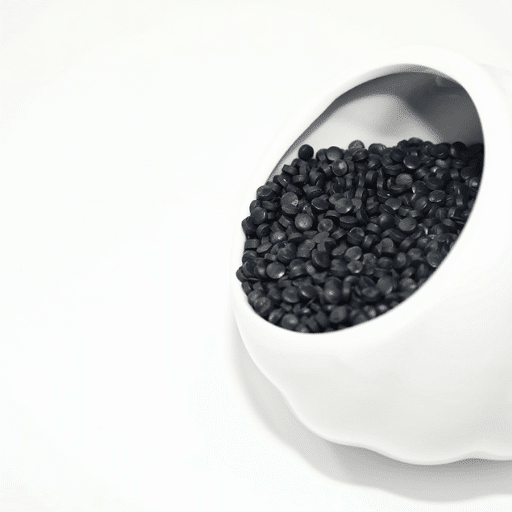
UV resistance is poor in natural or white grades. Prolonged outdoor exposure causes surface chalking, cracking, and loss of impact strength. UV-stabilized grades with carbon black or dedicated additives solve this problem. For marine fenders, dock bumpers, and outdoor liners, always specify a UV-stabilized grade.
Grade-Specific Property Variations
Not all UHMW is the same. The grade you choose changes the property profile significantly.
| Grade Type | Key Property Shift | Typical Use |
|---|---|---|
| Virgin standard powder (GUR 4120, UTEC 5541) | Maximum impact and wear | Compression molding, ram extrusion, liners |
| Injection-moldable pellets (GUR 5113, LUBMER) | Better flow, slightly lower toughness | Injection molded parts, complex geometries |
| Cross-linked | Higher temp limit, lower creep, reduced toughness | High-wear, elevated-temperature parts |
| Glass-filled | Higher hardness, lower thermal expansion | Dimensionally stable wear components |
| Ceramic/silicate-filled | Extreme abrasion resistance | Mining liners, bulk handling |
| UV-stabilized | Outdoor durability | Marine, dock, outdoor equipment |
| Antistatic/ESD | Controlled surface resistivity | Electronics, explosive atmospheres |
| Medical implant (GUR 1020/1050) | ISO 5834-2 compliance | Hip/knee bearings, surgical instruments |
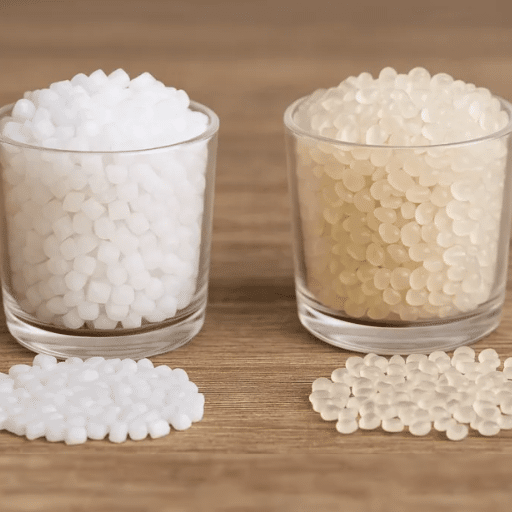
GUR 4120 is often used as the benchmark for high-MW UHMW powder. GUR 5113, a pelletized injection molding grade, has a sand-slurry wear index of about 130 versus 100 for GUR 4120. That means it wears roughly 30% faster in abrasive slurry service but processes much more easily. Mitsui LUBMER grades target low-friction injection and extrusion applications where quiet operation and easy flow matter. Read more about the differences between UHMW powder and pellet grades.
Medical grades are a separate world. They must meet ISO 5834-2 for implants and are often cross-linked or vitamin-E stabilized to reduce oxidative degradation. These grades are not interchangeable with industrial UHMW powder.
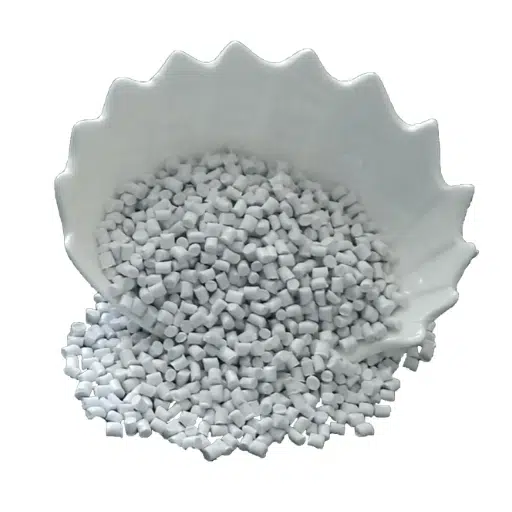
For help selecting between powder and pellet forms, read our UHMW plastic pellets buyer’s guide.
How UHMW Properties Compare to HDPE, Nylon, PTFE, and Acetal
Understanding UHMW means placing it next to the materials buyers usually consider. This table gives a quick procurement-oriented comparison.
| Property | UHMW | HDPE | Nylon 6/6 | PTFE | Acetal (POM) |
|---|---|---|---|---|---|
| Density (g/cm³) | 0.93 – 0.95 | 0.94 – 0.97 | 1.13 – 1.15 | 2.14 – 2.20 | 1.41 – 1.43 |
| Tensile yield (MPa) | 17 – 27 | 25 – 40 | 60 – 90 | 20 – 35 | 60 – 70 |
| Impact strength | Exceptional | Good | Good | Fair | Fair |
| COF dry on steel | 0.09 – 0.22 | 0.15 – 0.25 | 0.28 – 0.40 | 0.04 – 0.10 | 0.20 – 0.35 |
| Wear resistance | Excellent | Moderate | Good | Very good | Good |
| Moisture absorption | <0.01% | <0.01% | 1.5 – 3.0% | <0.01% | 0.2 – 0.5% |
| Max continuous temp | 80 – 90°C | 80 – 120°C | 80 – 120°C | 260°C | 90 – 110°C |
| Creep resistance | Poor | Moderate | Good | Very poor | Excellent |
| Machinability | Fair | Good | Good | Fair | Excellent |
| Relative cost | Medium | Low | Medium | High | Medium |
UHMW wins when wear resistance, impact strength, low friction, and chemical inertness matter most. It loses when you need high-temperature service, tight tolerances, or long-term structural load bearing. For those cases, acetal, nylon, or PTFE may be better choices. For a detailed three-way comparison, see how UHMW compares to nylon and PTFE.
For a focused two-material comparison, see our UHMW vs HDPE guide.
How to Verify UHMW Properties When Sourcing
Property values on a datasheet are only useful if you know what they mean and how they were measured. When you request a quote for UHMW pellets or powder, ask for these documents:
- Technical Data Sheet (TDS) with ASTM or ISO test methods listed
- Safety Data Sheet (SDS) for handling and regulatory compliance
- Certificate of Compliance (CoC) confirming grade and standards
- Molecular weight or intrinsic viscosity data to confirm UHMW classification
- RoHS and REACH declarations for EU and electronics markets
- FDA or ISO 5834-2 documentation for food or medical grades
Check that the quoted UHMW material properties match your application. A tensile strength at break of 45 MPa looks impressive, but it tells you little about load-bearing performance. For structural parts, tensile yield and creep data matter more. For liners, wear index and coefficient of friction are the critical numbers.
Always order a trial batch when switching grades or suppliers. Property variations between batches are normal, especially with recycled or reprocessed material. A 5-kilogram sample run through your process will reveal handling, flow, and performance issues that no datasheet can predict.
When Lin Wei, a sourcing manager at a packaging machinery company, switched UHMW suppliers to save 8%, the new pellets looked identical. But the melt behavior differed slightly, causing short shots in a critical conveyor component. The sample run caught the problem before full production. The savings would have cost far more in rework.
Ready to source UHMW with verified properties? We provide TDS, SDS, CoC, and trial batches for all UHMW grades. Request a quote and sample batch.
Frequently Asked Questions

Below are answers to the most common questions about UHMW material properties, from melting point and density to friction, chemical resistance, and grade selection.
What is the UHMW melting point?
Bulk UHMW typically melts between 130°C and 140°C. Highly oriented UHMWPE fibers can show melting points up to 144°C to 155°C due to crystal alignment.
What is the density of UHMW?
UHMW density ranges from 0.930 to 0.949 g/cm³. Virgin grades are less dense than water and will float.
What is the UHMW coefficient of friction?
The dynamic coefficient of friction against steel under dry conditions is typically 0.09 to 0.22. Many standard grades fall in the 0.10 to 0.15 range.
Is UHMW chemical resistance strong?
Yes. UHMW resists water, dilute acids, dilute alkalis, oils, greases, and many solvents. It is attacked by strong oxidizing acids, hot concentrated sulfuric acid, and some aromatic or chlorinated solvents at elevated temperatures.
What temperature range can UHMW handle?
UHMW performs continuously from about -200°C up to 80°C to 90°C. Short-term exposure to 120°C to 130°C is possible. Cross-linked and high-temp grades extend the upper limit.
Does UHMW absorb water?
No. Water absorption is below 0.01%, making UHMW highly stable in wet or submerged environments.
What are UHMW dielectric properties?
No. Standard UHMW is an excellent electrical insulator. Antistatic grades are available for applications that require controlled surface resistivity.
What are UHMW creep properties?
Yes. UHMW exhibits cold flow under sustained static load. Keep continuous compressive stress low, use metal backing, or choose filled/cross-linked grades for load-bearing parts.
Is UHMW UV resistant?
Standard natural or white UHMW has poor UV resistance. Use UV-stabilized or carbon-black-filled grades for outdoor applications.
Which UHMW grade has the best wear resistance?
High-molecular-weight virgin powder grades such as Celanese GUR 4120 generally offer the best wear resistance. Ceramic-filled grades provide extreme abrasion resistance for UHMW mining liner solutions and bulk handling.
Conclusion
UHMW material properties start with one number: molecular weight. Everything else flows from there. The ultra-long polymer chains give UHMW its exceptional impact strength, abrasion resistance, low friction, and chemical inertness. They also create the processing challenges that make grade selection so important.
For procurement and engineering teams, the key is to match the property profile to the application. Do not choose UHMW for high-temperature structural load. Do choose it when wear, impact, low friction, and chemical resistance dominate the design requirements. And always verify that the datasheet values you are comparing were measured the same way.
If you need help selecting a UHMW grade, interpreting a TDS, or sourcing UHMW pellets and powder globally, our team is ready to assist. We supply virgin, filled, UV-stabilized, food-grade, and injection-moldable UHMW grades with full documentation and 24-hour quote response.