Specifying a flexible material by name is how expensive mistakes get approved.
Most TPE vs PVC vs silicone comparisons pick a winner from the material label alone. That approach is why so many flexible parts arrive over-specified and overpriced, or under-specified and failing in service. These three materials are not competitors on a single scale. They are three chemistry families solving three different problems, and the right one is decided by your constraints, not the label.
Consider the parts lumped into the same buying conversation: a cable jacket, an IV line, a window seal, and a food-contact mat. All need to be flexible, yet each is constrained by a different variable: temperature, flex cycles, chemical exposure, compliance, recyclability, or cost.
This guide puts all three materials side by side with real property data and cost positioning. It covers the regulatory timeline now reshaping medical and food-contact sourcing, plus a decision framework you can apply to a specific part. Suzhou Yifuhui supplies thermoplastic elastomer (TPE) pellets, so we have a commercial interest here. We have written it honestly anyway, because a buyer who discovers mid-project that they were steered wrong never returns.
Working on a specific part right now? Send us the application details and our polymer specialists will recommend a material and return pricing within 24 hours.
TPE vs PVC vs Silicone at a Glance

| Property | PVC (flexible) | TPE (SEBS-based) | Silicone (LSR / HCR) |
|---|---|---|---|
| Chemistry | Plasticized vinyl, thermoplastic | Thermoplastic elastomer (SEBS/SEPS) | Crosslinked siloxane, thermoset |
| Density (g/cm³) | 1.16–1.40 | 0.88–1.05 | 1.05–1.40 |
| Hardness (Shore A) | 50–80 | 10–90, grade-dependent | 40–80 |
| Continuous service temp | 70–105 °C | 85–125 °C | Up to 200 °C, some grades 250 °C |
| Low-temp flexibility | −25 to −40 °C | −50 to −70 °C | −60 to −100 °C |
| Compression set (70 °C × 24 h) | ~40% | ~22% | ~25% |
| Flex life | Under 1 million cycles | 10 million+ cycles | 3–5 million cycles |
| Abrasion resistance | Good | Excellent | Poor |
| UV / ozone resistance | Poor without additives | Excellent | Excellent |
| Sterilization | EtO; limited gamma | EtO, gamma (stable to ~50 kGy) | EtO, gamma, autoclave |
| Plasticizer-free | No, may contain DEHP | Yes | Yes |
| Melt-recyclable | Partial | Yes, fully | No, thermoset |
| Relative cost | $ | $$ (1.5–2x PVC) | $$$ (2–4x PVC) |
No column wins every row. Silicone owns the temperature extremes but loses badly on abrasion and tear. PVC wins on cost and clarity but carries plasticizer and halogen baggage. TPE sits in the middle and wins the widest band of industrial parts.
Read the PVC vs TPE vs silicone columns by row rather than by material, and the trade-offs resolve themselves.
Independent lab-tubing testing reaches the same split: the Cole-Parmer tubing material showdown rates TPE as the only weldable option of the three, silicone as the temperature leader, and PVC as the cost leader.
Which rows does your application actually constrain? A part that never exceeds 60 °C and never flexes under load does not need silicone’s thermal headroom. Paying for it is insurance against a risk you do not have.
What Are the Main Differences Between PVC, Silicone, and TPE?
TPE is a melt-processable thermoplastic elastomer: flexible, weldable, and fully recyclable. PVC is a low-cost vinyl plastic that needs plasticizers for flexibility and carries phthalate and halogen concerns. Silicone is a thermoset rubber built on a silicon-oxygen backbone, offering the widest temperature range and the best biocompatibility at the highest cost.
The structural difference underneath those definitions decides almost everything else:
- PVC is a vinyl polymer chain that would be rigid on its own. Plasticizer molecules wedge between chains to make it soft. Those molecules are not chemically bonded, so they can migrate out over time, into heat, and into whatever the part touches.
- TPE builds rubber-like soft segments onto a thermoplastic backbone. It behaves like rubber in service and like a plastic in the press, which means it melts, flows, and can be reground and remolded repeatedly.
- Silicone links its chains into a permanent three-dimensional network through curing. Once that network forms, the material cannot be melted again. That permanence delivers the temperature range, and it also closes the door on recycling.
For a deeper two-way treatment, see our TPE vs PVC comparison guide and our TPE vs silicone material selection guide.
Comparing TPE, PVC, and Silicone by Property

Temperature Resistance
Silicone is the only practical choice when continuous service exceeds roughly 125 °C, or when the part must stay flexible below about −50 °C. That is not a marketing claim; it is the direct consequence of the silicon-oxygen bond’s thermal stability.
By contrast, PVC has the narrowest window of the three. Continuous use tops out around 70–105 °C, and the material stiffens and can crack at −25 to −40 °C. Plasticizer volatility compounds the problem: as it leaves, the part hardens and loses the flexibility you specified.
TPE covers roughly −50 °C to 125 °C. That range handles the large majority of consumer, automotive interior, and single-use medical parts. It is the practical middle, not a compromise.
Mechanical Properties and Flex Life
In practice, flex life separates these materials more sharply than any single mechanical number. Flexible PVC typically survives under 1 million flex cycles before cracking. Silicone reaches 3–5 million. SEBS-based TPE formulations routinely exceed 10 million.
Compression set tells the same story. In an indicative comparison at 70 °C for 24 hours, PVC measured around 40%, silicone around 25%, and TPE around 22%. Treat those figures as directional rather than design values, and always specify the test method (ISO 815-1) and grade on your datasheet. PVC loses sealing force under sustained compression, so it struggles in long-term static seal duty.
Silicone’s weakness is the opposite of its strength. It resists heat beautifully and tears easily. A nick in a silicone seal propagates, and its abrasion resistance is the poorest of the three. Any dynamic part that rubs, slides, or gets handled roughly belongs in TPE unless temperature rules it out.
For the full property picture across the TPE family, see our TPE material properties guide.
Chemical, UV, and Environmental Resistance
PVC handles water and many general chemicals well, but it is not ozone-resistant and is attacked by aromatics, chlorinated hydrocarbons, and oxidizing acids. UV exposure requires stabilizer packages that add cost and complexity.
TPE, in contrast, delivers excellent UV and ozone resistance, which is why it dominates automotive exterior sealing. Its weakness is oil and fuel resistance, and many SEBS grades perform poorly there. Grade selection matters enormously here, and some formulations also pick up dust or feel tacky without the right additive package.
Silicone offers broad chemical stability and outstanding aging performance, but weak oil and fuel resistance of its own. None of the three is a general-purpose chemical barrier.
Biocompatibility and Regulatory Compliance
In the TPE vs PVC vs silicone medical comparison, platinum-cured silicone leads on biocompatibility. It meets USP Class VI, ISO 10993, FDA, and LFGB requirements, and it survives autoclave sterilization, which the other two largely cannot.
Medical-grade TPE is close behind. Formulations meet ISO 10993-5, some achieve USP Class VI, and they are naturally phthalate-free, BPA-free, DEHP-free, and latex-protein-free. That is why TPE has become the default PVC replacement in medical devices; our TPE vs PVC medical device comparison covers the compliance detail.
PVC can be formulated to medical standards, and DEHP-free plasticizers have existed for years. The problem is direction, not capability.
Recyclability and Sustainability
TPE is the only one of the three that is fully melt-recyclable, and it is halogen-free. Scrap returns to the hopper, a sustainability and cost argument in one.
Flexible PVC is partially recyclable, but it contains chlorine. As a result, incineration risks hydrogen chloride and dioxin formation, and plasticizer stewardship complicates end-of-life handling.
Silicone is the awkward case. It burns without producing organic halides, so it is cleaner than PVC in a fire. But it is a thermoset, so it cannot be reprocessed at all. Its durability is real, and its end-of-life story is poor.
The Regulations Reshaping the TPE vs PVC vs Silicone Decision
For a growing share of buyers, this choice is no longer made by an engineer alone but by a compliance calendar.
- California: DEHP is banned in intravenous bags from January 1, 2026. Eleven substitute plasticizers are also prohibited, which closes the obvious workaround.
- Pennsylvania: Senate Bill 804, passed 48–1 in March 2026, sets a DEHP phase-out for medical devices by 2035.
- European Union: Regulation 2023/2482 identifies DEHP as a substance of concern with a final application deadline of January 1, 2029, giving manufacturers a 36-month reformulation window.
- EU REACH: DEHP faces a sunset date of July 1, 2030.
- EU MDR: Annex I §10.4 requires a benefit-risk assessment once a CMR or endocrine-disrupting substance exceeds 0.1% by weight in device materials.
In practice, the consequences differ by material. PVC stays viable only with DEHP-free reformulation and a supporting extractables and leachables package, which runs roughly $300,000 and nine months per program. TPE arrives as a drop-in replacement with no plasticizer to defend. Silicone remains the reference point for reusable, implant-adjacent, and high-temperature duty.
One honest caveat belongs here: PVC is not exiting the market. It remains cost-effective for high-volume disposables where plasticizer migration is not a clinical concern and gamma sterilization is not used. Claims that PVC is finished are as overstated as claims that it is unregulated.
Processing, Tooling, and Manufacturing Differences

How Each Material Is Processed
TPE runs on standard injection molding and extrusion equipment with no vulcanization step. It overmolds onto rigid substrates such as polypropylene, ABS, and polycarbonate, and its flash can be reground.
PVC runs on the same standard equipment, but compounding plasticizers and stabilizers is part of the process.
Silicone is the outlier. Liquid silicone rubber (LSR) requires metered pumping, mixing, and heated-cure tooling. High-consistency rubber (HCR) requires compression molding. Either way, scrap is not reusable.
Our LSR vs TPE processing comparison breaks down the tooling and cycle-time implications.
Cycle Time and Tooling Implications
TPE runs fastest of the three and its scrap is reusable, which moves effective cost per part far more than the resin invoice suggests. Our TPE injection molding guide covers the cycle-time mechanics.
How to Choose: A 5-Question Decision Framework
Run your part through these five questions in order; the first hard yes decides the material.
- Does continuous service temperature exceed 125 °C, or drop below −50 °C? If yes, choose silicone. Nothing else in this group survives it.
- Does the part flex repeatedly, beyond roughly 1 million cycles, or take abrasion? If yes, choose TPE. Silicone fails on tear and abrasion; PVC fails on flex life.
- Is the part static, indoor, and cost-critical? If yes, PVC is defensible, provided it flexes well under a million cycles and is not heat-critical.
- Must the part be welded, sealed, or thermally bonded? If yes, choose TPE. Neither PVC nor silicone can be weld-sealed.
- Must the material be recyclable, halogen-free, or plasticizer-free? If yes, choose TPE.
If none of the five constrains your part, optimize for total cost per finished part instead.
Application Fit by Industry
| Application | Best fit | Runner-up | Why |
|---|---|---|---|
| Medical tubing, single-use | Medical-grade TPE | Silicone | Plasticizer-free, weldable, gamma-stable, E&L-friendly |
| Implant-adjacent, reusable, autoclavable | Silicone | None | USP Class VI, 200 °C capable, autoclave-compatible |
| Wire and cable jacketing | LSZH TPE | PVC | Halogen-free flame retardance, flex life, no plasticizer migration |
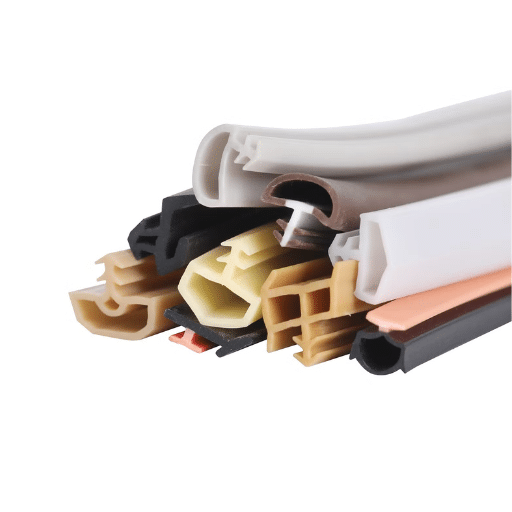
| Automotive window and door seals | TPE / TPV | Silicone | Compression set, UV and ozone resistance, co-extrusion |
| Food contact | Silicone or food-grade TPE | PVC, limited | LFGB and FDA compliance without leaching risk |
| Consumer soft-touch grips | TPE | None | Overmolding, tunable hardness, no tack after compounding |
| High-temperature seals and gaskets | Silicone | None | Only option that holds above 125 °C continuously |
| Budget static interior parts | PVC | TPE | Cost and clarity sufficient for non-critical duty |
Two rows deserve a closer look. Wire and cable jacketing is the largest single substitution happening today, driven by halogen-free requirements. We cover it in our TPE vs PVC wire and cable guide. Food contact is the second, where grade-level compliance matters more than material family, as our food-grade TPE vs PVC comparison explains.
The governing rule for rubber articles in food contact is FDA 21 CFR Part 177 Subpart C, which sets the extraction limits a compliant grade must meet.
Two application rows have dedicated deep-dives of their own. Automotive window and door seals are where this trade-off is decided most often, and our TPE vs silicone automotive seals guide walks through compression set, UV exposure, and co-extrusion. Consumer soft-touch grips depend on choosing the right member of the TPE family before tooling starts, which our TPE vs TPV vs TPU comparison explains.
TPE vs PVC vs Silicone Cost: Where Each Material Sits

Flexible PVC compound is the floor at typically 1.20–1.20–1.60 per kilogram. General-purpose SEBS-based TPE-S runs 2.25–2.25–3.95 per kilogram, and medical-grade TPE climbs higher still. Silicone is the most expensive of the three and, critically, the only one whose scrap cannot be recovered.
Two factors flip part of that gap. For one, TPE is 20–30% less dense than PVC, so the same mold cavity uses less material mass. TPE also accepts 30–50% regrind, against under 8–15% for PVC and effectively zero for silicone.
That per-kilogram gap can shrink to roughly parity per finished part once compliance testing and scrap are counted honestly. We work through the full model in our TPE vs PVC cost guide and our TPE vs silicone cost comparison.
Sourcing TPE, PVC, and Silicone Materials
Whichever material your application selects, the sourcing process is the same.
- Demand a datasheet with test conditions. A density figure without a standard, or a compression set without temperature and duration, is not a specification.
- Verify compliance for your market, not your supplier’s. FDA, LFGB, ISO 10993, and USP Class VI are not interchangeable. A certificate for one does not transfer to another.
- Check batch consistency. Density (specific gravity), hardness, and melt flow should be quoted with tolerances, not as single values.
- Confirm the regrind policy. A supplier who cannot state a regrind percentage has not tested it.
- Ask for lead times in writing. Material transitions fail on logistics far more often than on chemistry.
Suzhou Yifuhui supplies TPE and TPV pellets alongside a broad portfolio of standard and engineering resins, including PC, PA66, POM, ABS, PPS, and PMMA. That range matters when your assembly pairs a flexible overmold with a rigid substrate: one supplier can cover both halves of the part in one shipment.
Ready to specify? Explore our TPE pellet grades and our team responds within 24 hours.
Frequently Asked Questions

Which is better: TPE, PVC, or silicone?
None is universally better. Silicone wins above 125 °C and in implant-adjacent or autoclavable applications. PVC wins on cost in static, indoor, non-heat-critical parts. TPE wins the broad middle: dynamic parts, flexible parts needing weld or overmold capability, and any application where recyclability or plasticizer-free composition matters.
Is silicone more expensive than TPE?
Yes. Silicone typically costs two to four times flexible PVC, while general-purpose TPE runs roughly 1.5 to 2 times PVC. Silicone also produces non-reusable scrap, which widens the effective cost gap beyond the raw material price.
Can TPE replace silicone?
Often, yes, and it is the more common substitution direction today. TPE can replace silicone wherever service temperature stays under about 125 °C and extreme chemical or sterilization demands are absent. It cannot replace silicone in autoclavable, high-temperature, or implant-adjacent duty.
Is PVC still used in medical devices?
Yes, and it remains legitimate for high-volume disposables without gamma sterilization. However, DEHP restrictions are steadily narrowing where flexible PVC can be specified without reformulation. California’s ban began in January 2026, EU Regulation 2023/2482 lands in January 2029, and the REACH sunset follows in July 2030.
Which of the three is recyclable?
TPE is fully melt-recyclable and halogen-free. Flexible PVC is partially recyclable but contains chlorine and depends on plasticizer stewardship. Silicone is a thermoset and cannot be remelted or reprocessed at all.
What is the temperature range of TPE vs PVC vs silicone?
Continuous service range is roughly 70–105 °C for flexible PVC, 85–125 °C for TPE, and up to 200 °C for silicone, with some grades reaching 250 °C. Low-temperature flexibility follows the same order, from about −25 °C for PVC to −100 °C for silicone.
Conclusion: Match the Material to the Application
Silicone earns its premium only when temperature, biocompatibility, or sterilization demands it. Over-specifying it is one of the most common and most expensive errors in flexible part design. PVC remains a legitimate cost choice for static, indoor, non-critical parts, though the regulatory direction is against it in regulated markets. TPE occupies the broad middle and wins the largest share of industrial applications, combining flex life, weldability, recyclability, and plasticizer-free composition.
The recurring lesson in TPE vs PVC vs silicone selection is that the winner is set by the constraint, not by the material name. Identify the one property your application cannot compromise, and the shortlist collapses to a single answer.
Give us that constraint and we will help you specify the grade. Contact our polymer specialists for material recommendations, specification sheets, and pricing within 24 hours. To learn more about What Is TPE-S? Properties, Types, and Applications and TPE Automotive Window Seals: Glass Run Channel Guide, please refer to our accompanying guides.