A single out-of-spec lot of plastic pellets can shut down an injection molding line for hours. That was precisely what happened to Lisa Chen, a procurement manager at an automotive supplier in Guangdong. Her team received a PA66 order that looked fine in the sealed bag, but the moisture reading came back at 0.35%. When the material hit the barrel, splay streaks appeared across every connector. By the time the lot was quarantined, 2,000 parts had been scrapped and the line had lost half a shift.
Stories like this are why polyester and polyamide quality control deserves more than a quick glance at a certificate of analysis. These two polymer families dominate engineering plastics, yet they fail in fundamentally different ways. Polyester resins are vulnerable to hydrolysis at melt temperature, while polyamide resins soak up atmospheric moisture and degrade when dried incorrectly or not at all. For procurement managers, plant managers, and product engineers, understanding these differences is not an academic exercise. It is a direct path to fewer defects, lower scrap rates, and a more reliable supply chain.
In this guide, you will learn why polyester and polyamide quality control differ, which incoming tests matter most, what defects to watch for, and how to evaluate a supplier’s quality systems. We will also show how a manufacturing partner with rigorous lot traceability and responsive technical support can remove much of the guesswork.
Want a reliable material partner before your next purchase? Contact our polymer experts to discuss your exact pellet specifications.
Why Polyester and Polyamide Quality Control Are Not the Same

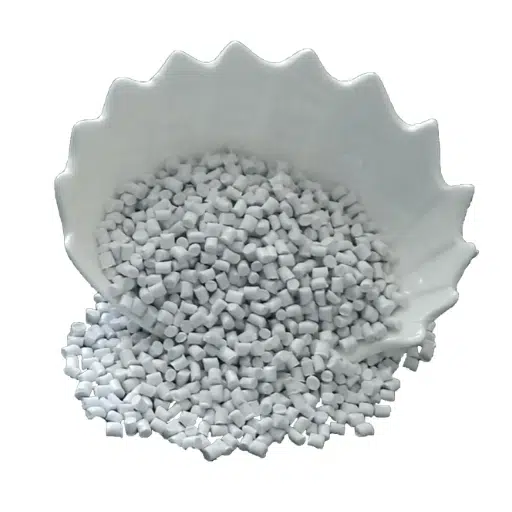
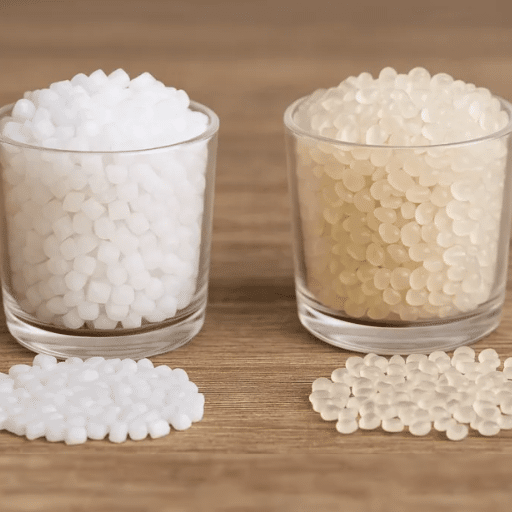
At first glance, polyester and polyamide pellets can look almost identical: small cylindrical or lentil-shaped granules in opaque bags. Beneath that surface, however, their molecular backbones create entirely different risks for incoming inspection and processing.
Polyester: Hydrolysis-Sensitive Ester Bonds
Polyester, whether PET or PBT, contains ester linkages in its polymer chain. These linkages are naturally stable under normal storage conditions, but at injection molding temperatures they become highly sensitive to residual moisture. If a pellet is not dried to the correct level, the water reacts with the chain during melting. The result is hydrolytic degradation, a permanent reduction in molecular weight that shows up as brittleness, lower melt strength, and poor part performance.
For this reason, polyester quality control centers on two numbers: moisture content and intrinsic viscosity. PET and PBT must typically be dried to 0.02-0.03% moisture before molding, which is far below what casual handling can deliver. Intrinsic viscosity, or IV, is the most practical measure of remaining molecular weight. A drop in IV from a stated baseline is a clear warning that the material has already degraded somewhere in the supply chain.
Polyamide: Hygroscopic Amide Bonds
Polyamide, commonly called nylon, uses amide bonds that make the polymer highly hygroscopic. PA6 and PA66 can absorb roughly 4% moisture regain when exposed to humid air, according to common industry data comparing polyamide vs polyester textiles. This moisture does not merely sit on the surface; it penetrates the pellet and must be driven out before processing.
For polyamide quality control, the target moisture level before molding is usually below 0.2%, and ideally 0.1-0.15%. Drying temperature matters just as much as drying time. Standard recommendations call for drying PA6 and PA66 at around 80C for 4-8 hours. A PA6 composite with carbon fiber reinforcement may need 95C for 6-8 hours, as noted in recent polymer processing research. Go too hot, and oxidation yellows the material. Go too short, and residual moisture causes hydrolysis with chain scission that can reduce tensile strength by 30-50%.
Quick Comparison: Polyester vs Polyamide Quality Control
| Property | Polyester (PET/PBT) | Polyamide (PA6/PA66) |
|---|---|---|
| Moisture regain | ~0.4% | ~4% |
| Target moisture before molding | 0.02-0.03% | <0.2% (ideally 0.1-0.15%) |
| Key QC test | Intrinsic viscosity (IV) | Relative viscosity (ASTM D789 / ISO 307) |
| Dominant defect driver | Hydrolysis + thermal degradation | Moisture + hydrolysis |
| Typical drying conditions | 120-130C for 3-6 hours | 80C for 4-8 hours |
This table alone explains why you cannot run one incoming-inspection routine for both materials. A plant manager who treats polyester like polyamide, or vice versa, invites the exact defects that drive scrap and downtime.
Incoming Material Inspection: What Buyers Should Verify
The best quality control starts before the pellet ever reaches the hopper. A robust incoming inspection program protects your line and gives you leverage with suppliers when a lot falls short.
Certificate of Analysis (COA) Review
Every lot should arrive with a COA that goes beyond the grade name. Verify the lot number, production date, melt flow index, intrinsic or relative viscosity, density, and additive package. The key question is whether the COA reports actual test results from that specific lot or merely prints the generic specification range. Results-driven COAs are far more valuable than spec sheets that could apply to any batch.
Also confirm compliance with the standards your end product requires. Automotive components may need IATF 16949 traceability. Electronics may require RoHS and REACH declarations. Food-contact or medical applications may need FDA or EU compliance documentation. If the certificates are missing, request them before unloading the material into inventory.
Moisture Content and Drying Verification
Do not rely entirely on supplier labels. Polyamide in particular can reabsorb moisture in transit, especially if packaging is damaged or the container sat on a humid dock. Spot-check each lot with Karl Fischer titration or a calibrated capacitance moisture analyzer. For hygroscopic polymers, gravimetric loss-on-drying gives a useful secondary reading, though Karl Fischer is generally more accurate for trace moisture.
If your plant uses desiccant dryers, confirm that the dew point at the dryer outlet is at least -20C. Ambient hot-air dryers are not adequate for nylon or PET. This single equipment decision can make or break your polyamide quality control results.
Pellet Appearance and Lot Consistency
Visual inspection is simple, fast, and surprisingly informative. Look for uniform 2-4 mm pellet size, clean cuts, and consistent color from bag to bag. Reject lots that contain tails, angel hair, agglomerates, black specks, excess dust, or foreign contamination. Even slight discoloration can signal thermal degradation during pelletization at the supplier.
The goal of incoming inspection is to catch problems while you still have options: return the lot, re-dry it conditionally, or adjust the supplier scorecard. Once bad material is in the hopper, the cost multiplies quickly.
Need a consistent pellet source with detailed COAs for every lot? Get a custom quote for polyamide or polyester grades from Yifuhui.
Critical Quality Control Tests for Polyester and Polyamide Pellets

After visual and documentation checks, several laboratory tests separate acceptable lots from risky ones.
Viscosity and Molecular Weight Tests
For polyamide, relative viscosity testing to ASTM D789 or ISO 307 remains the standard way to track molecular weight and detect degradation. The test dissolves the polymer in 90% formic acid and compares flow time against solvent alone. A lower reading than the supplier’s stated baseline means chain scission has occurred.
For polyester, intrinsic viscosity measurement replaces relative viscosity. A drop in IV signals hydrolytic degradation. Because IV testing is sensitive and repeatable, many molders of PET and PBT parts test incoming pellets before production and again after molding to confirm that processing conditions did not further degrade the resin.
Thermal Analysis
Differential scanning calorimetry, or DSC, measures melting point, crystallization behavior, and degree of crystallinity. This matters because semi-crystalline polymers behave very differently depending on their thermal history. Heat deflection temperature testing to ASTM D648 or ISO 75 confirms that the grade can withstand the service temperature of the final part.
Mechanical Property Verification
Tensile strength and elongation at break, flexural modulus, and notched Izod impact strength verify that the lot matches the datasheet. These tests become especially important for glass-filled or mineral-filled grades, where the filler content and dispersion directly affect stiffness, impact resistance, and dimensional stability.
Moisture Analysis Methods
Karl Fischer titration remains the reference method for trace moisture. Gravimetric loss-on-drying is faster and cheaper but can miss tightly bound water. Near-infrared spectroscopy is increasingly used for inline, non-destructive moisture checks, allowing molders to verify dryer performance without waiting for lab turnaround.
Common Defects and Their Root Causes
When polyester or polyamide quality control fails, the defects are usually visible, expensive, and traceable to a small set of root causes.
Splay, Silver Streaks, and Voids
Splay appears as silver or fan-shaped marks on the part surface. It is almost always caused by residual moisture flashing to steam during injection. The fix is almost always better drying: correct temperature, adequate time, and a desiccant dryer with a low dew point. Because both polyester and polyamide are sensitive to moisture, splay is the single most common defect plants see when switching back and forth between these materials.
Brittleness and Degradation
Hydrolytic or thermal chain scission lowers molecular weight. Undried nylon can reportedly lose 30-50% of its tensile strength, a figure documented in many polyamide processing guides. The same mechanism affects polyester when IV drops. The first confirmation test should be viscosity: if relative viscosity or IV is below the baseline, the material has degraded and should not be used for critical parts.
Warpage and Dimensional Issues
Polyamide has high shrinkage and anisotropic behavior, especially in glass-filled grades. Fiber orientation can create differential shrinkage that warps long, thin parts. Polyester crystallization behavior varies sharply between PET and PBT, so mold temperature and cooling rate must be matched to the specific grade. Mold trials on new lots help establish the processing window before full production.
Color and Contamination Defects
Black specks usually indicate degraded material left in the barrel, carbon buildup from previous runs, or contamination at the pellet supplier. Yellowing points to overheating or insufficient stabilizer package. These defects are not corrected by process adjustment; they require lot segregation and supplier feedback.
Processing-Stage Quality Control

Incoming inspection is only half the battle. Processing conditions must protect the resin from the moment it leaves the dryer.
Drying Protocols
Use desiccant dryers with monitored dew point for both polymer families. Document drying time, temperature, and final moisture reading for each lot. Do not assume that a slightly longer dry cycle is harmless; excessive heat can oxidize polyamide and cause yellowing or embrittlement.
Melt Temperature and Residence Time
Run the barrel in the middle of the supplier’s recommended range, not at the upper limit. Minimize residence time, especially in hot runners or large barrels processing small shot weights. Long residence times at high temperature accelerate thermal degradation.
Mold Temperature and Cooling
PA6 and PA66 molds typically run at 80-100C to promote proper crystallization and surface finish. PET often requires higher mold temperatures or nucleated grades to control crystallinity. PBT generally processes at lower mold temperatures than PET but still benefits from consistent thermal control.
These process-stage controls work hand-in-hand with polyester and polyamide quality control at the receiving dock. The combination is what delivers stable, repeatable part quality.
Supplier Evaluation: Quality Systems to Demand
A strong supplier does more than ship on time. It provides documentation, traceability, and technical support that make your incoming inspection easier and your processing more predictable.
Certifications and Standards
At minimum, look for ISO 9001:2015 certification. Automotive programs should require IATF 16949. Depending on the application, you may also need RoHS, REACH, FDA, or EU compliance declarations.
Lot Traceability and COA Quality
Every lot should be traceable to raw material batch, production date, and test results. The COA should include actual measured values, not just published specification ranges. A supplier that cannot provide this quickly is asking you to accept unverified material.
Technical Support and Documentation
Material datasheets, processing guides, and defect troubleshooting support should be available on request. When a lot behaves unexpectedly, fast access to a polymer specialist can mean the difference between a quick correction and a line-wide shutdown.
This is where the supplier relationship becomes a true partnership. A vendor ships boxes. A manufacturing partner helps you protect your production schedule.
How Yifuhui Ensures Polyester and Polyamide Pellet Quality

Suzhou Yifuhui New Material Co., Ltd. supplies standard and engineering plastic pellets to manufacturers worldwide. Our approach to polyester and polyamide quality control reflects the procurement and production realities described in this guide.
- Rigorous incoming resin inspection verifies lot identity, appearance, documentation, and baseline properties.
- Moisture-controlled storage and packaging protects hygroscopic grades like PA6 and PA66 from reabsorption before shipment.
- Detailed COAs and technical datasheets accompany every lot, giving you the data needed for incoming inspection.
- Lot traceability links each shipment back to production batch and raw material origin.
- Global shipping with protective packaging reduces transit risks, including moisture ingress and contamination.
- Seven-day technical support with a 24-hour response guarantee helps resolve drying, processing, and defect questions quickly.
Whether you need PET, PBT, PA6, PA66, or specialized filled grades, we combine competitive pricing with the quality systems manufacturers rely on. You can learn more about our broader polymer guidance in our polyamide vs polyester comparison, our polyester pellets guide, our polyamide pellets guide, our How to Choose a Polyester and Polyamide Supplier, and our advice on storing polyester and polyamide pellets.
Conclusion
Polyester and polyamide quality control is not a single checklist. It is a sequence of checks that begins with supplier evaluation, continues through incoming inspection and drying, and extends into processing controls. The chemistry explains the differences: polyesters fail through hydrolysis at melt temperature, while polyamides fail because they absorb moisture and degrade when not dried properly.
The practical results are clear. Verify moisture. Test viscosity. Inspect every lot visually and document the COA. Demand traceability and strong supplier quality systems. Connect each QC point to a real manufacturing outcome: fewer splay defects, less brittleness, reduced warpage, and more predictable production schedules.
If your team is sourcing polyester or polyamide pellets, the next step is simple. Request material specifications, compare COAs, and talk with a supplier who can support your process, not just fill your order. Contact Yifuhui’s polymer specialists for a custom quote or technical consultation on your next project.